From our shop to your home
A little care goes a long way.
Get to know 40 familiar houseplants, with real photographs and simple advice to help them thrive. Find your plant below, or scan the care label on its pot.
Find your plant
40 plants to explore
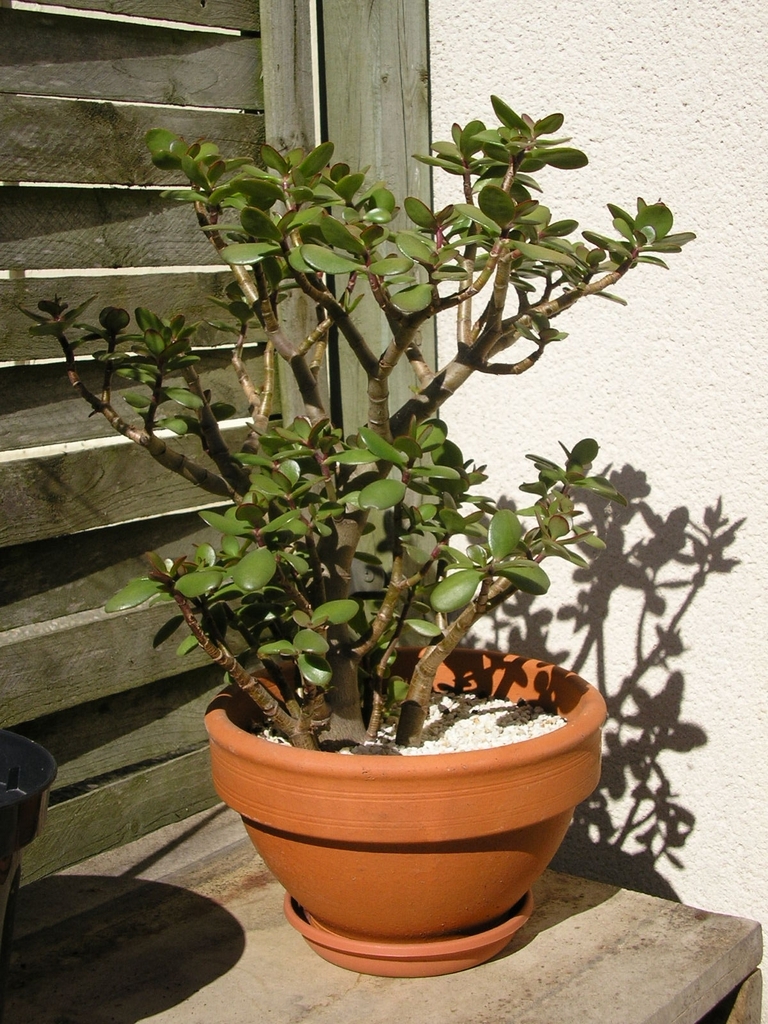
Jade plant / money plant
Crassula ovata
Care advice for Jade plant / money plant
Thick, rounded leaves grow in opposite pairs on branching stems that become woody with age.
- Light
- A bright windowsill suits it well. Introduce stronger sunshine gradually to avoid scorching the leaves.
- Water
- Let the compost dry between waterings, then water and drain fully. It needs much less water in a cool, darker winter room.
- Pot & compost
- Use peat-free cactus or succulent compost in a pot with drainage holes.
- A little extra care
- A little succulent feed during active growth is enough. Healthy stem or leaf cuttings can be used to grow new plants.
- What to look out for
- Soft stems or yellowing leaves with persistently wet compost can indicate overwatering.
Keep away from pets that chew plants.
Further reading: RHS · NC State Extension
Photo: Cyril Gourdan · CC BY-SA 3.0 · Photo source
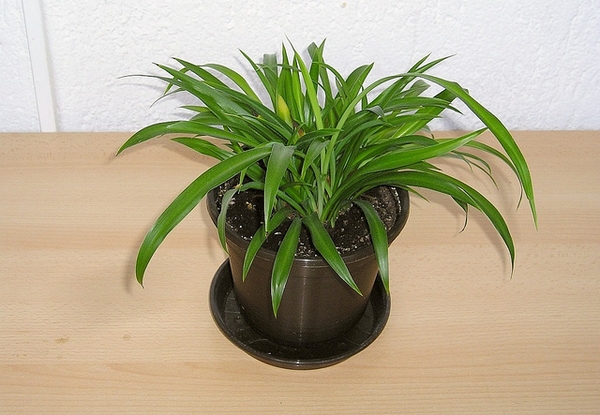
Spider plant
Chlorophytum comosum
Care advice for Spider plant
Arching, strap-like leaves are green or striped. Mature plants often produce little plantlets on long stems.
- Light
- Bright, indirect light is ideal. Protect it from strong midday sun; very deep shade slows growth.
- Water
- Water when the surface of the compost begins to dry, allowing the pot to drain. Check less often in winter, when growth slows.
- Pot & compost
- Use a free-draining, peat-free houseplant compost and a pot with drainage holes.
- A little extra care
- Feed lightly while growing. Plantlets can be rooted in small pots, giving you new plants to share.
- What to look out for
- Brown tips can have several causes, including dry conditions, excess fertiliser or salts in the water. Check its conditions before adding more feed.
Further reading: RHS · NC State Extension
Photo: Maja Dumat · CC BY 4.0 · Photo source
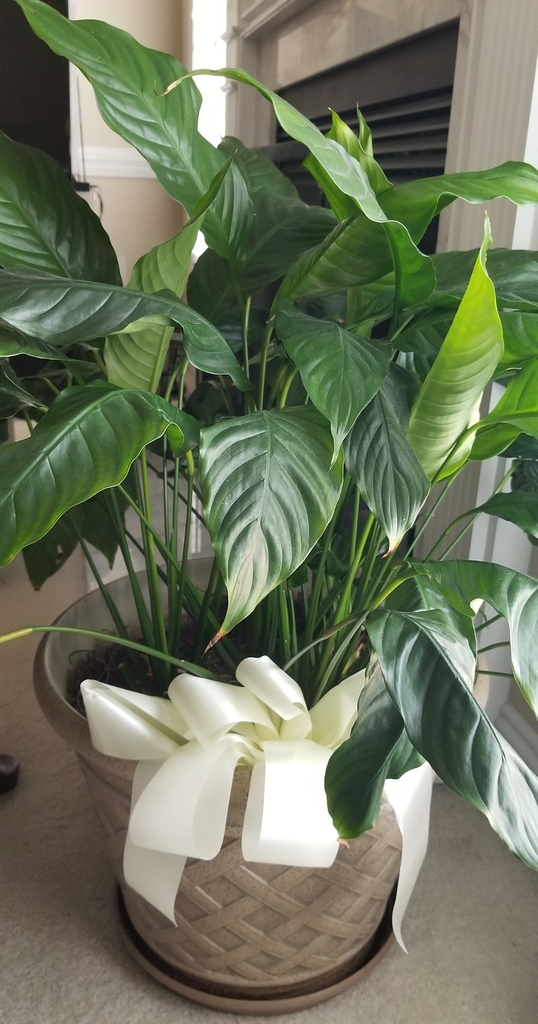
Peace lily
Spathiphyllum
Care advice for Peace lily
Glossy, pointed green leaves rise from the base. The white, hood-like flower bracts surround an upright central spike.
- Light
- Give it indirect light, away from scorching sunshine. A brighter position usually encourages more flowers.
- Water
- Let the top of the compost dry slightly, then water and drain. Keep the rootball gently moist rather than soggy, and reduce watering in winter.
- Pot & compost
- Use a moisture-retentive but free-draining, peat-free houseplant compost.
- A little extra care
- Wipe dust from the leaves and remove faded flower stems near the base. Feed lightly while the plant is actively growing.
- What to look out for
- Drooping can mean dry compost, but wet, damaged roots can also cause it. Check the pot before watering again.
Harmful if chewed or eaten; keep away from children and pets that chew plants.
Further reading: RHS · NC State Extension
Photo: Cindy Christian · CC BY 4.0 · Photo source
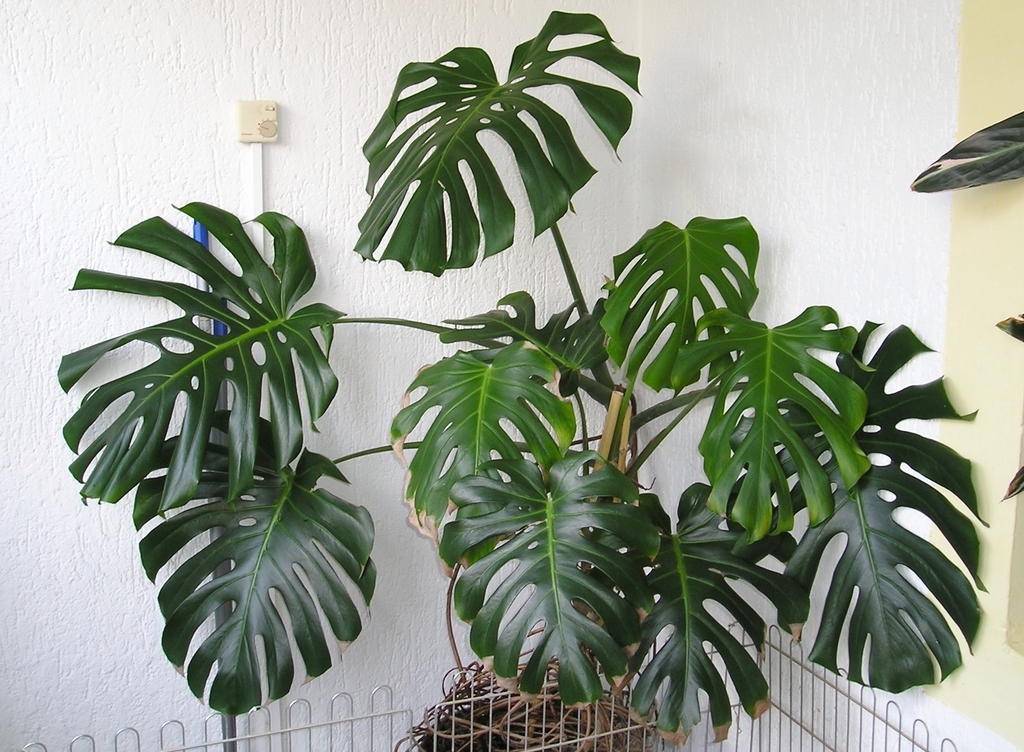
Monstera / Swiss cheese plant
Monstera deliciosa
Care advice for Monstera / Swiss cheese plant
Large, heart-shaped leaves develop splits and holes as the plant matures. Young leaves may be completely solid.
- Light
- Choose bright, indirect light. Protect leaves from strong direct summer sun.
- Water
- Allow the upper few centimetres of compost to dry before watering thoroughly. Let all excess water drain away.
- Pot & compost
- Use an airy, free-draining, peat-free houseplant mix and a pot with drainage holes.
- A little extra care
- Give climbing stems a sturdy support, wipe dust from leaves and feed lightly during active growth.
- What to look out for
- Yellow leaves and wet compost can point to overwatering. A young plant without leaf holes is not necessarily unhealthy.
Sap can irritate; avoid chewing or eating the plant and wash hands after handling cut stems.
Further reading: RHS · NC State Extension
Photo: Maja Dumat · CC BY 2.0 · Photo source
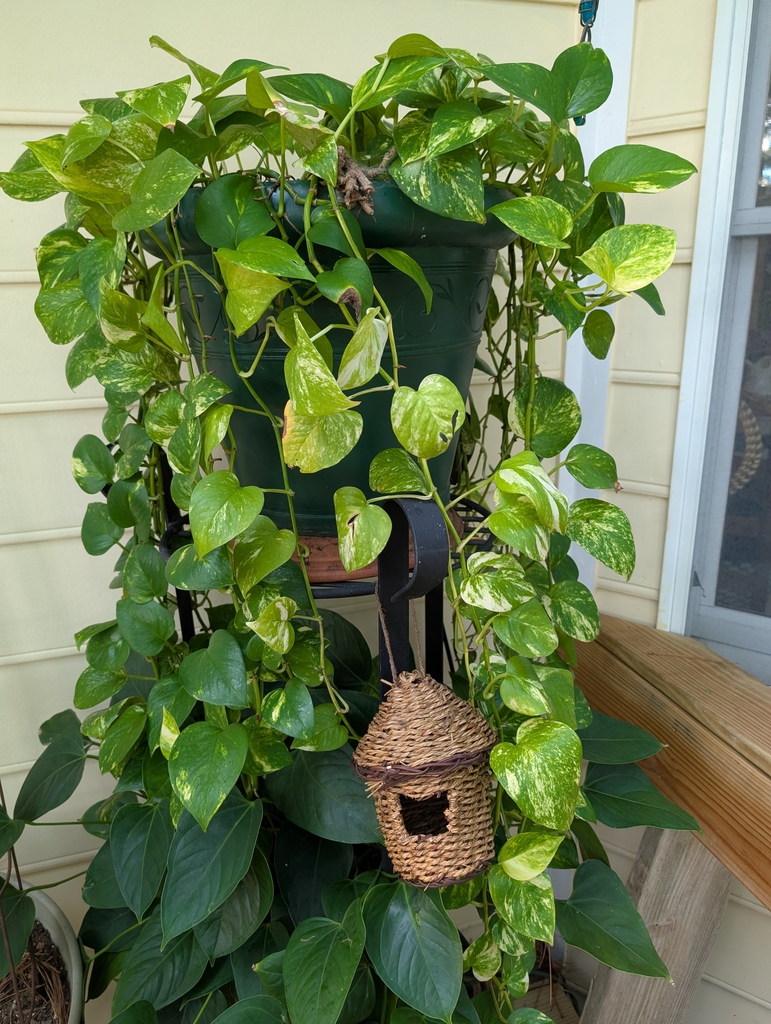
Pothos / devil’s ivy
Epipremnum aureum
Care advice for Pothos / devil’s ivy
Heart-shaped leaves grow along trailing or climbing stems. Many varieties have yellow, cream or pale-green markings.
- Light
- Bright, indirect light keeps growth fuller and helps maintain variegation. It tolerates lower light, but grows more slowly.
- Water
- Let the upper part of the compost dry before watering. Drain thoroughly and water less often when growth slows.
- Pot & compost
- Use a free-draining, peat-free houseplant compost in a pot with drainage holes.
- A little extra care
- Trim long stems to encourage a bushier plant. Stem cuttings that include a node can root to make new plants.
- What to look out for
- Blackened edges and wet compost can indicate root problems. Markings may fade if the position is too dark.
Harmful if chewed or eaten; keep away from children and pets that chew plants.
Further reading: RHS · NC State Extension
Photo: Dell Enecks (Pitt County) · CC BY 4.0 · Photo source
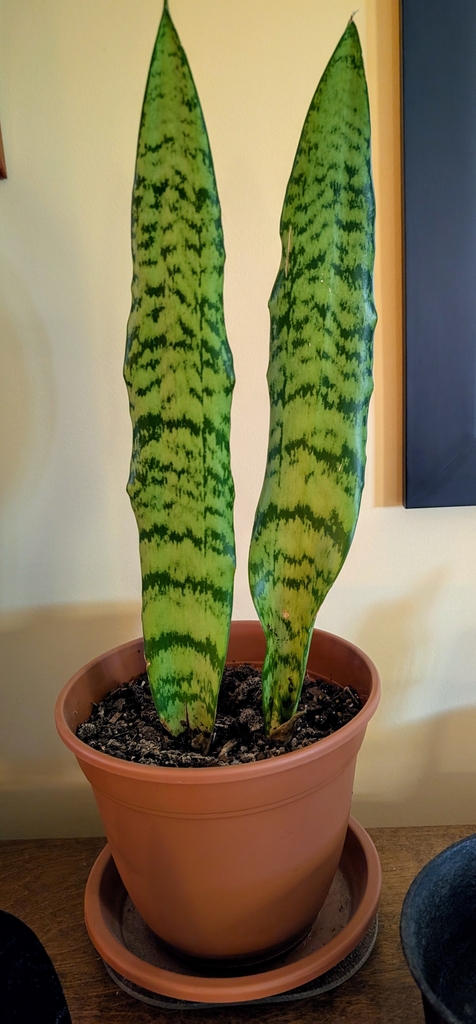
Snake plant
Dracaena trifasciata
Also known as Sansevieria trifasciata
Care advice for Snake plant
Stiff, upright, sword-shaped leaves have green banding; some varieties also have yellow edges.
- Light
- It grows best in good light, but tolerates light shade. Introduce direct sunshine gradually.
- Water
- Let the compost dry right through before watering again. It may need very little water in winter; do not water just because a week has passed.
- Pot & compost
- Use free-draining, peat-free cactus compost. Never leave the inner pot standing in water.
- A little extra care
- Wipe the leaves occasionally and feed sparingly during active growth.
- What to look out for
- Soft, yellowing leaf bases with wet compost can indicate too much water. Choose a warm position away from cold draughts.
Keep away from pets that chew plants.
Further reading: RHS · NC State Extension
Photo: Dell Enecks (Pitt County) · CC BY 4.0 · Photo source
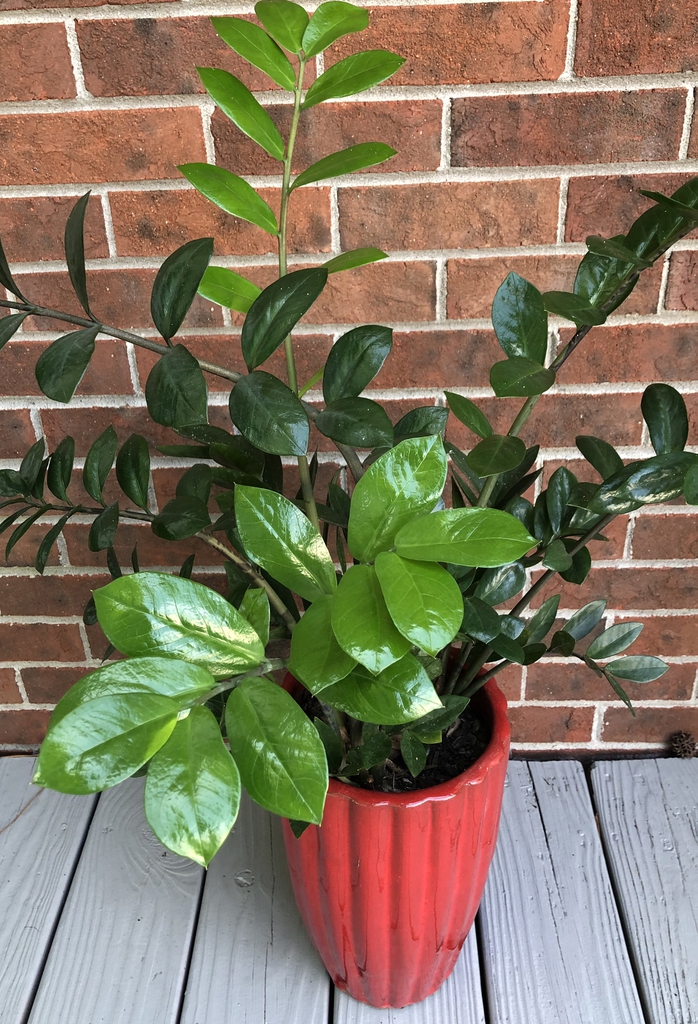
ZZ plant
Zamioculcas zamiifolia
Care advice for ZZ plant
Glossy, oval leaflets sit in pairs along thick, upright stalks. The plant grows slowly from swollen underground rhizomes.
- Light
- Bright, indirect light is best. It copes with lower light, but avoid intense direct sunshine.
- Water
- Let the compost dry between waterings. Its fleshy roots store water, so a damp pot is a reason to wait, not add more.
- Pot & compost
- Use a free-draining, peat-free houseplant mix and a pot with drainage holes.
- A little extra care
- Remove dust gently and feed only occasionally during active growth. Slow growth is normal.
- What to look out for
- Yellowing stalks and constantly wet compost can indicate overwatering. Reduce watering further in a darker winter position.
Harmful if chewed or eaten; keep away from children and pets that chew plants.
Further reading: NC State Extension
Photo: Susan Broderick · CC BY-SA 4.0 · Photo source
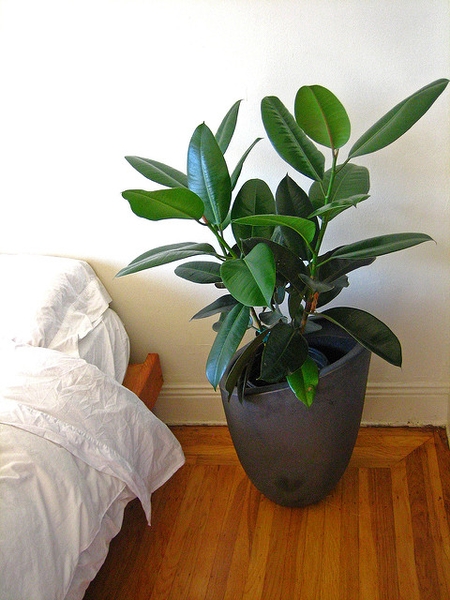
Rubber plant
Ficus elastica
Care advice for Rubber plant
Large, thick, oval leaves grow on upright stems. Varieties may be deep green, burgundy or variegated with cream and pink.
- Light
- Choose bright, indirect light, particularly for variegated varieties. Protect it from strong afternoon summer sun.
- Water
- Let the top few centimetres of compost dry, then water and drain fully. Water less often when winter growth slows.
- Pot & compost
- Use free-draining, peat-free houseplant compost. Move up only a little in pot size when roots need more room.
- A little extra care
- Wipe the broad leaves with a damp cloth and keep it in a steady, warm position. Feed lightly while growing.
- What to look out for
- Leaf drop can follow cold draughts, a sudden change of conditions or overwatering.
Milky sap can irritate skin. Wear gloves when pruning and keep cut material away from children and pets.
Further reading: NC State Extension
Photo: Margaret Shear · CC BY-SA 4.0 · Photo source
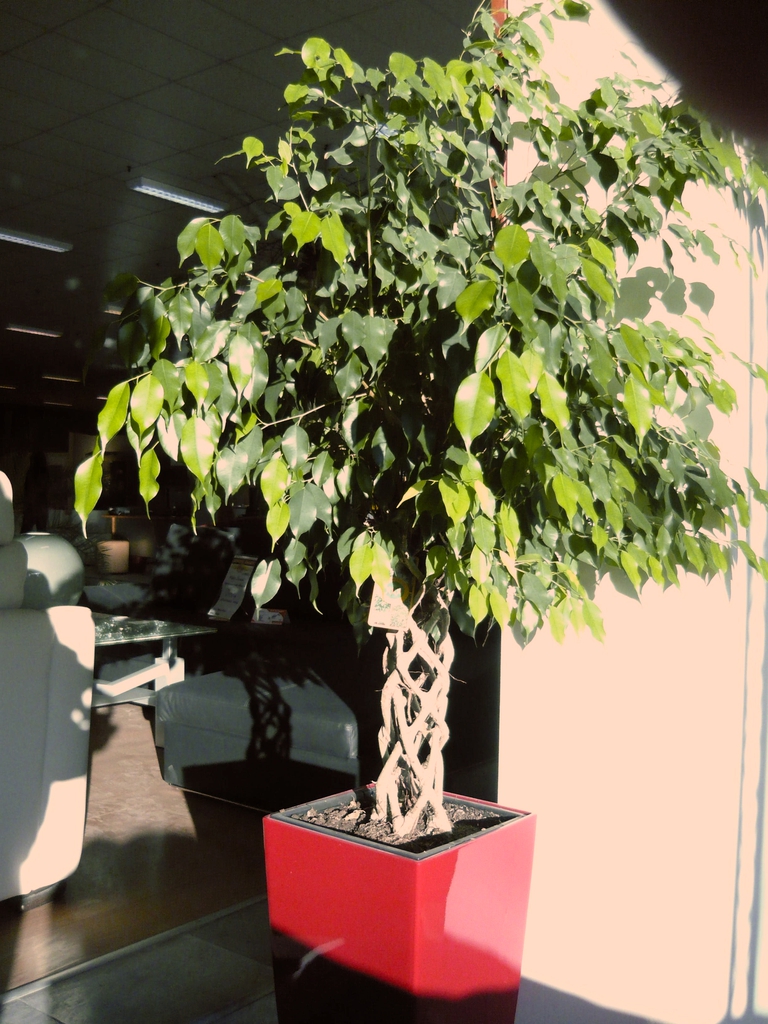
Weeping fig
Ficus benjamina
Care advice for Weeping fig
Slender, arching branches carry many small, pointed oval leaves. Some plants have cream-edged foliage or braided stems.
- Light
- Give it bright, indirect light and a stable position away from cold draughts.
- Water
- Allow the surface to dry slightly before watering. Keep some moisture lower in the pot, without leaving it waterlogged.
- Pot & compost
- Use free-draining, peat-free houseplant compost in a pot with drainage holes.
- A little extra care
- Try not to move it repeatedly between different light levels. Feed lightly during active growth.
- What to look out for
- A change of location can trigger leaf drop. Check light, temperature and moisture before assuming it needs more water.
Milky sap can irritate skin. Wear gloves when pruning and keep away from pets that chew plants.
Further reading: NC State Extension
Photo: Darsie · CC0 · Photo source
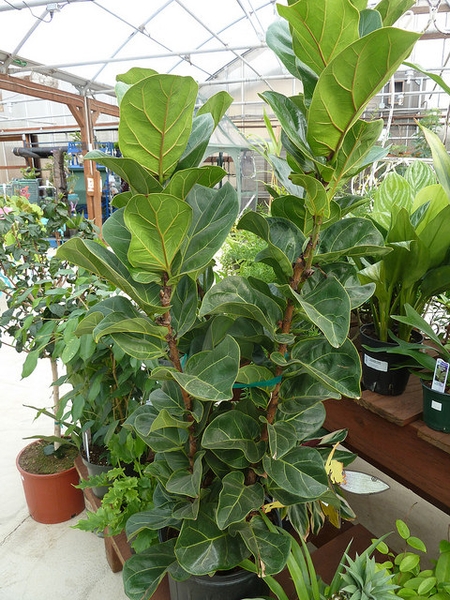
Fiddle-leaf fig
Ficus lyrata
Care advice for Fiddle-leaf fig
Broad, leathery leaves have a violin-like outline, prominent veins and gently wavy edges.
- Light
- Give it plenty of bright, indirect light. Protect it from harsh afternoon sun and cold draughts.
- Water
- Let the top few centimetres of compost dry before watering thoroughly. Drain away excess water rather than leaving the pot in a full saucer.
- Pot & compost
- Use a free-draining, peat-free houseplant compost. Avoid moving it into a much larger pot.
- A little extra care
- Keep conditions steady, wipe dust from the leaves and feed lightly while growing.
- What to look out for
- Brown patches or leaf drop have several possible causes, including watering problems and temperature changes. Check the roots and position before treating it.
Milky sap can irritate skin. Wear gloves when pruning; harmful if chewed or eaten.
Further reading: NC State Extension
Photo: NC Cooperative Extension · CC BY 2.0 · Photo source
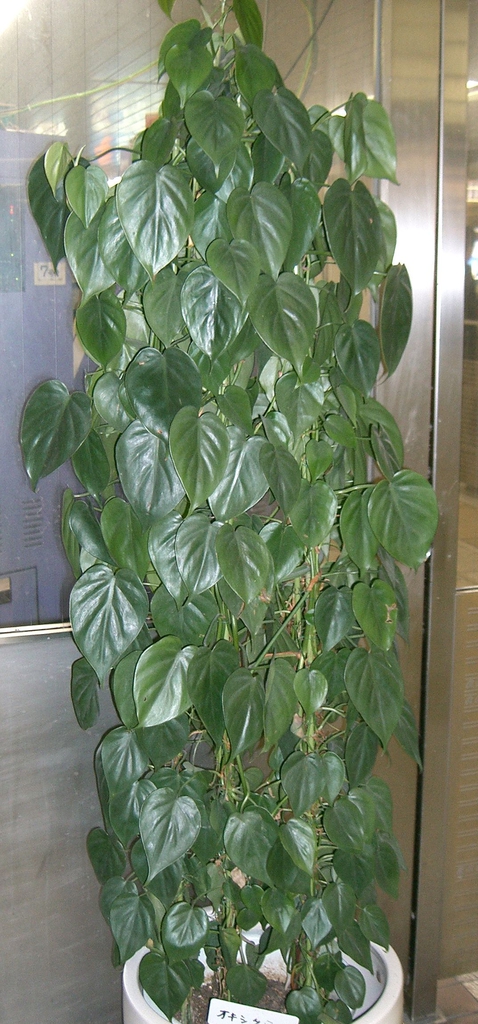
Heartleaf philodendron
Philodendron hederaceum
Also sold as Philodendron scandens
Care advice for Heartleaf philodendron
Pointed, heart-shaped leaves grow along slim stems that can trail from a shelf or climb a support.
- Light
- Medium to bright, indirect light suits it well. Lower light is tolerated, but avoid scorching direct sunshine.
- Water
- Let the surface of the compost begin to dry before watering. Keep the roots gently moist, never sitting in water, and reduce watering in winter.
- Pot & compost
- Use an airy, free-draining, peat-free houseplant mix.
- A little extra care
- Provide a support or let stems trail. Trim long shoots to keep a fuller shape and feed lightly during active growth.
- What to look out for
- Persistently wet compost can cause root rot. Check leaf undersides for pests if growth becomes weak or marked.
Harmful if chewed or eaten; keep away from children and pets that chew plants.
Further reading: NC State Extension
Photo: KENPEI · CC BY-SA 3.0 · Photo source
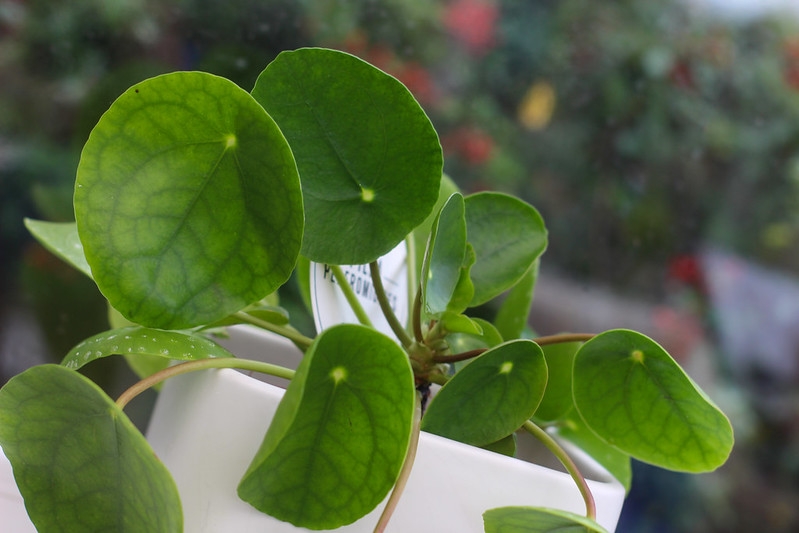
Chinese money plant
Pilea peperomioides
Care advice for Chinese money plant
Round, coin-like leaves sit on long stalks attached near the middle of each leaf. Small offsets often appear around the base.
- Light
- Bright, indirect light is ideal. Keep it away from strong midday sun, radiators and cold draughts.
- Water
- Let the surface of the compost dry slightly, then water and drain. Avoid keeping the pot constantly wet.
- Pot & compost
- Use a free-draining, peat-free houseplant compost and a pot with drainage holes.
- A little extra care
- Turn the pot occasionally for even growth. Well-rooted offsets can be separated during the growing season.
- What to look out for
- Long, stretched stems can indicate insufficient light. Wet compost encourages root problems.
Further reading: NC State Extension
Photo: Kevin Walsh · CC BY 2.0 · Photo source
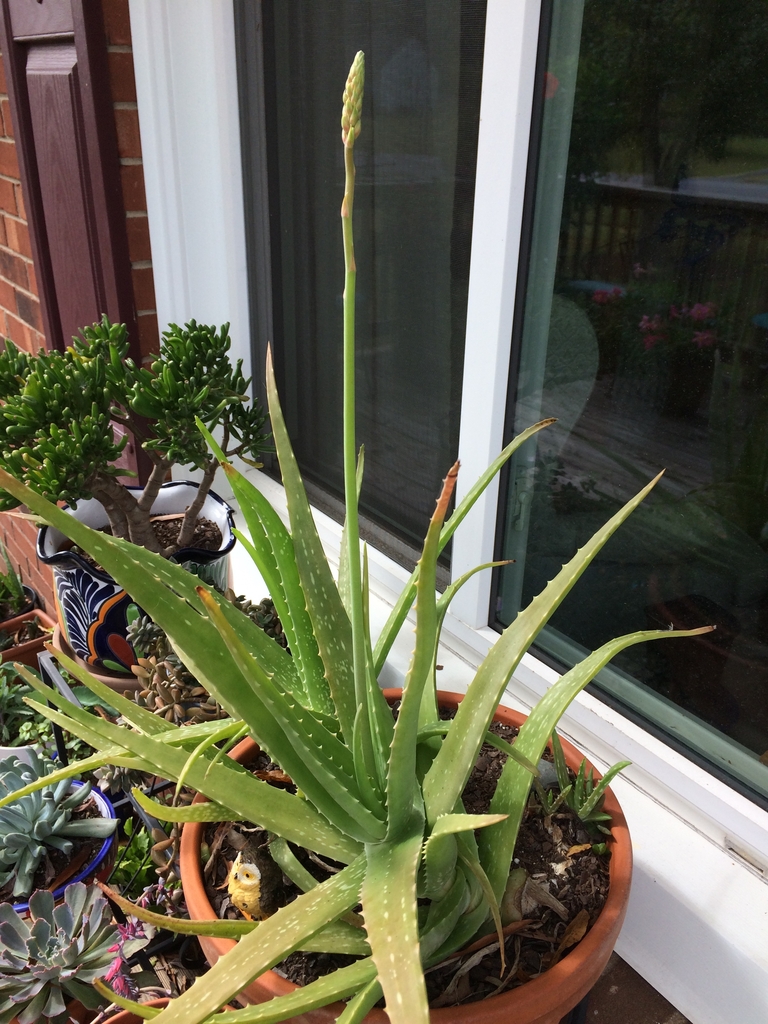
Aloe vera
Aloe vera
Care advice for Aloe vera
Fleshy, pointed leaves form a rosette, with small teeth along the edges. Young plants may have pale spots.
- Light
- Choose a very bright position. Introduce direct sunshine gradually so leaves have time to adjust.
- Water
- Allow the compost to dry fully between waterings, then water and drain. Give very little water during a cool, low-light winter.
- Pot & compost
- Use gritty, peat-free cactus or succulent compost and a pot with drainage holes.
- A little extra care
- Separate well-rooted offsets when repotting. Feed only lightly during active growth.
- What to look out for
- Soft leaves and a wet pot can indicate overwatering. Do not let water collect in the centre of the rosette.
Keep away from pets that chew plants. This guide covers growing the plant, not using it as a food or treatment.
Further reading: NC State Extension
Photo: K. Andre · CC-BY-SA 2.0 · Photo source
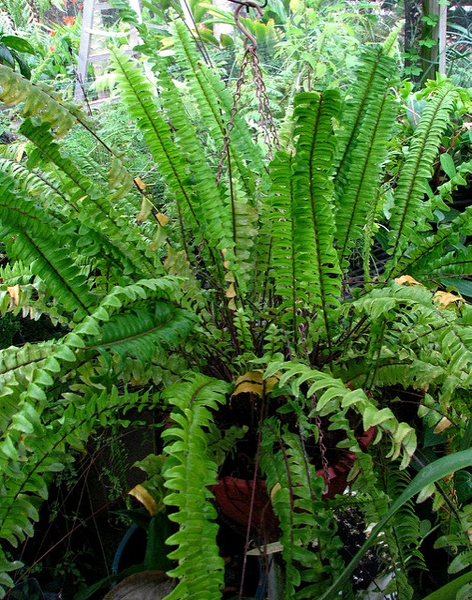
Boston fern
Nephrolepis exaltata
Care advice for Boston fern
Many arching, feathery green fronds form a soft, spreading clump, often displayed in a hanging pot.
- Light
- Choose bright, indirect light, away from scorching sunshine and hot radiators.
- Water
- Keep the compost gently moist. Water as the surface begins to dry, rather than letting the whole rootball dry out. Always drain away excess.
- Pot & compost
- Use a moisture-retentive but free-draining, peat-free houseplant compost.
- A little extra care
- A naturally humid room with daylight suits it well. Remove dead fronds near the base and feed lightly while growing.
- What to look out for
- Dry, brittle fronds can follow dry compost or dry air. Neat rows of brown dots on the undersides may be normal spores.
Further reading: NC State Extension
Photo: David Eickhoff · CC BY 2.0 · Photo source
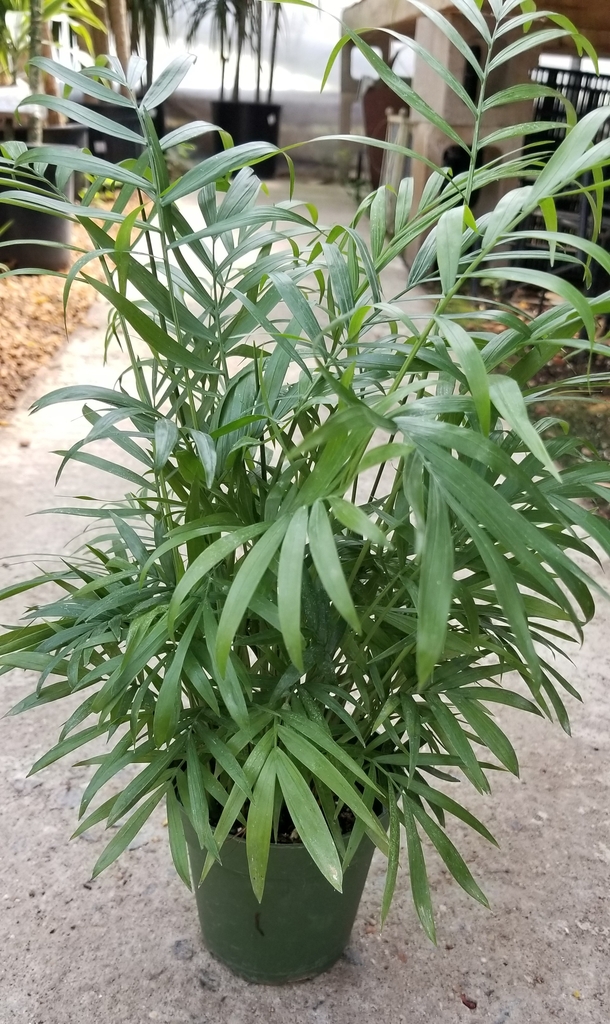
Parlour palm
Chamaedorea elegans
Care advice for Parlour palm
Fine, feathery fronds rise from thin green stems. Several young palms are often grown together in one pot.
- Light
- Bright, indirect light is best. It tolerates a little shade, but strong direct sun can damage the fronds.
- Water
- Allow the upper compost to dry slightly before watering. Drain fully and reduce watering when growth slows in winter.
- Pot & compost
- Use free-draining, peat-free houseplant compost. Repot only when needed, into a slightly larger container.
- A little extra care
- Keep it out of cold draughts and feed lightly during active growth. Remove fully brown fronds near the base.
- What to look out for
- Check for spider mites or mealybugs if the fronds become discoloured. Avoid trying to fix every brown tip with extra water.
Further reading: NC State Extension
Photo: Cindy Christian · CC BY 4.0 · Photo source
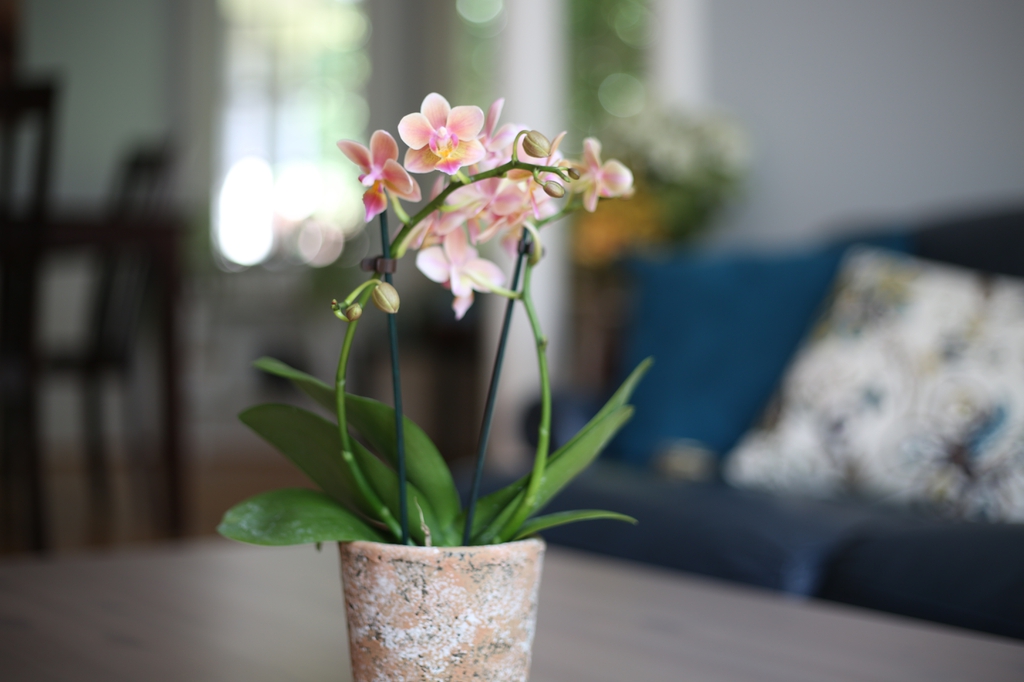
Moth orchid
Phalaenopsis hybrids
Care advice for Moth orchid
Thick, broad leaves form a small clump beneath arching flower stems. Pale aerial roots often grow outside the pot.
- Light
- Bright, filtered light is ideal. Keep it out of strong direct summer sun and in a consistently warm room above 16°C.
- Water
- Water as the bark begins to dry, using tepid water, then drain completely. Do not leave it standing in water or let water sit in the leaf crown.
- Pot & compost
- Use specialist bark-based orchid compost, not ordinary multipurpose compost. A clear pot makes checking the roots easier.
- A little extra care
- Use orchid feed lightly during active growth, following the label. Repot when the bark breaks down, usually about every two years.
- What to look out for
- Firm, pale or green aerial roots are normal. Soft, hollow or rotting roots need attention to watering and compost.
Further reading: RHS · NC State Extension
Photo: Hope Duckworth · CC BY 4.0 · Photo source
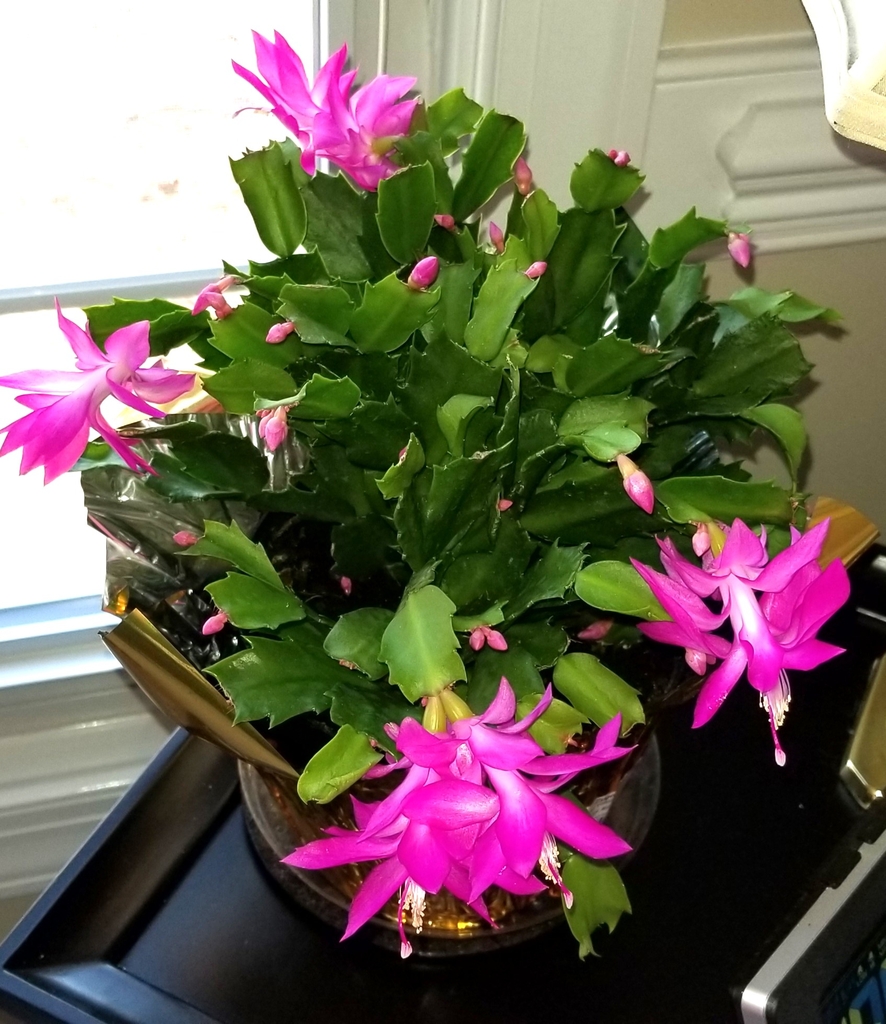
Christmas cactus
Schlumbergera hybrids
Care advice for Christmas cactus
Flat, joined stem segments trail over the pot, with colourful flowers at the tips. Segment edges may be rounded or pointed.
- Light
- Give it bright, indirect light. This is a tropical forest cactus, so protect it from harsh direct sunshine.
- Water
- Keep the compost lightly moist while growing and flowering. During cooler rest periods, let the top few centimetres dry, but do not dry the whole pot completely.
- Pot & compost
- Use free-draining, peat-free cactus compost in a snug pot with drainage holes.
- A little extra care
- A cooler spell around 12–15°C in early autumn helps encourage buds. Reduce watering during the rest, then resume regular checks as buds develop.
- What to look out for
- Sudden temperature changes or watering problems can cause buds to drop. Keep flowering plants in a steady position.
Further reading: RHS · NC State Extension
Photo: Cindy Christian · CC BY 4.0 · Photo source
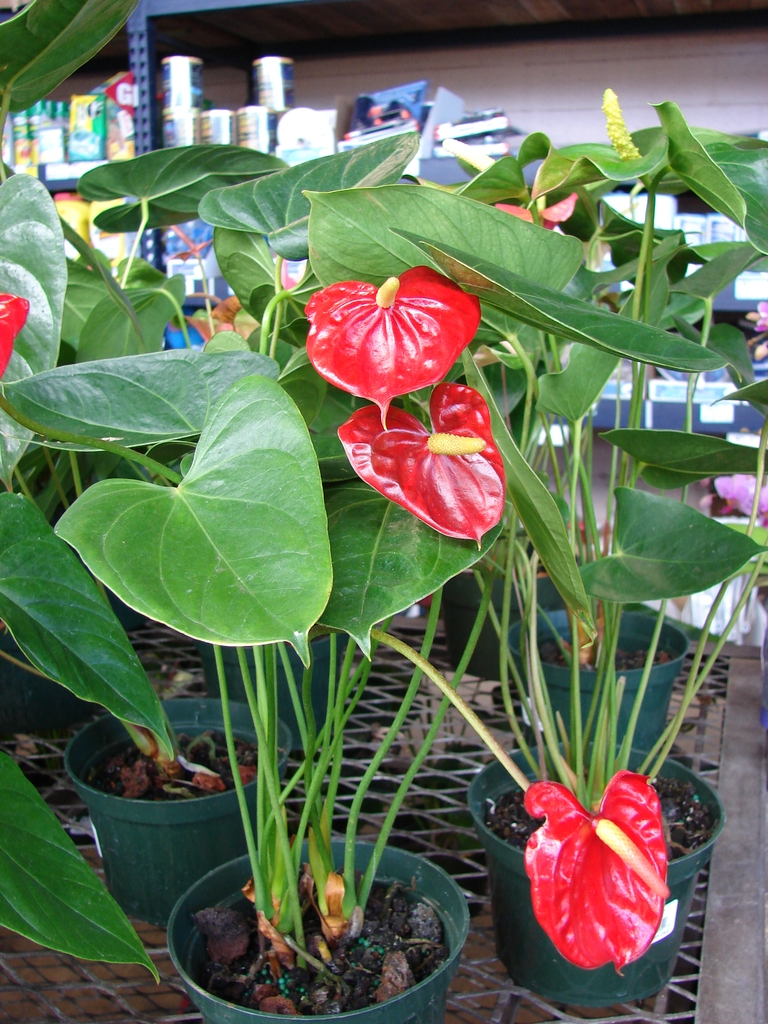
Flamingo flower
Anthurium andraeanum hybrids
Care advice for Flamingo flower
Glossy, heart-shaped leaves sit below colourful, waxy bracts with a central flower spike. Bracts may be red, pink or white.
- Light
- Bright, indirect light encourages flowering. Protect it from direct sun and cold draughts.
- Water
- Water when the top few centimetres of compost feel dry. Keep some moisture below, but let excess water drain away.
- Pot & compost
- Use an airy, free-draining, peat-free houseplant mix rather than dense, waterlogged compost.
- A little extra care
- Choose a warm, humid position with good light. Feed lightly while growing and remove faded flower stems.
- What to look out for
- Low light can reduce flowering. Yellow leaves can have several causes, so check drainage and watering before adding fertiliser.
Harmful if chewed or eaten; keep away from children and pets that chew plants.
Further reading: NC State Extension
Photo: Forest and Kim Starr · CC BY 3.0 · Photo source
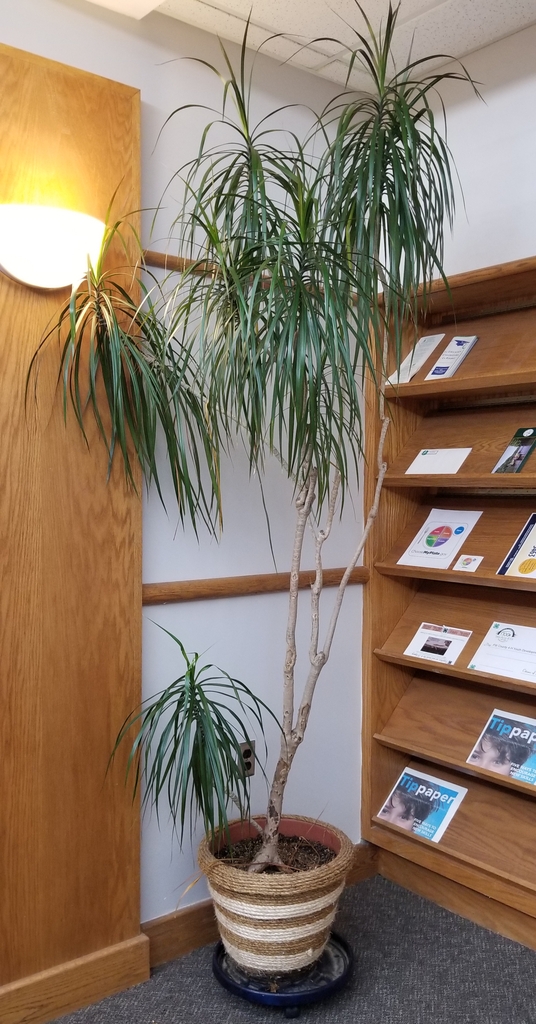
Dragon tree
Dracaena reflexa var. angustifolia
Also known as Dracaena marginata
Care advice for Dragon tree
Tufts of long, narrow leaves grow from upright woody canes. Leaves often have reddish edges, sometimes with cream stripes.
- Light
- Choose bright, indirect light. Avoid intense sunshine and cold draughts.
- Water
- Let the upper part of the compost dry before watering again, without leaving the whole rootball dry for a prolonged period. Drain fully.
- Pot & compost
- Use a free-draining, peat-free houseplant compost in a pot with drainage holes.
- A little extra care
- It needs little feeding. Wipe dust from the leaves and feed sparingly during active growth.
- What to look out for
- Brown tips can be linked to water quality as well as care conditions. If the problem persists, consider rainwater or distilled water.
Keep away from pets that chew plants.
Further reading: NC State Extension
Photo: Cindy Christian · CC BY 4.0 · Photo source
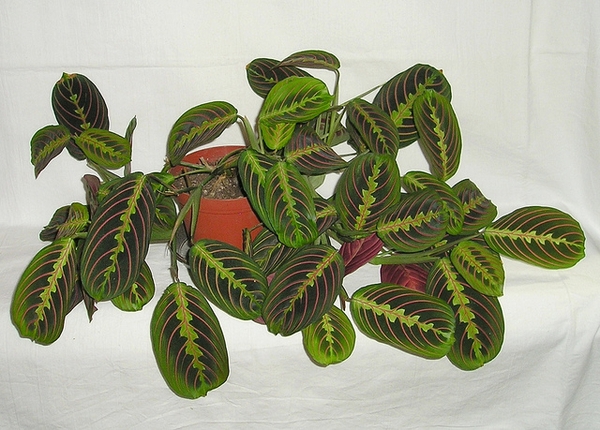
Prayer plant
Maranta leuconeura
Care advice for Prayer plant
Broad, patterned oval leaves spread from a low clump. Leaves often lift or fold upward at night.
- Light
- Choose bright, filtered or indirect light. Strong direct sunshine can fade or scorch the markings.
- Water
- Keep the compost lightly moist during growth, never soggy. Reduce watering in winter, allowing the surface to dry a little between checks.
- Pot & compost
- Use a moisture-retentive but free-draining, peat-free houseplant mix.
- A little extra care
- Provide warmth and humidity away from radiators and cold draughts. Feed lightly during active growth; too much fertiliser can damage leaves.
- What to look out for
- Curling or dry edges can follow dry conditions. Check moisture and humidity, and look for pests on leaf undersides.
Further reading: RHS · NC State Extension
Photo: Maja Dumat · CC BY 4.0 · Photo source
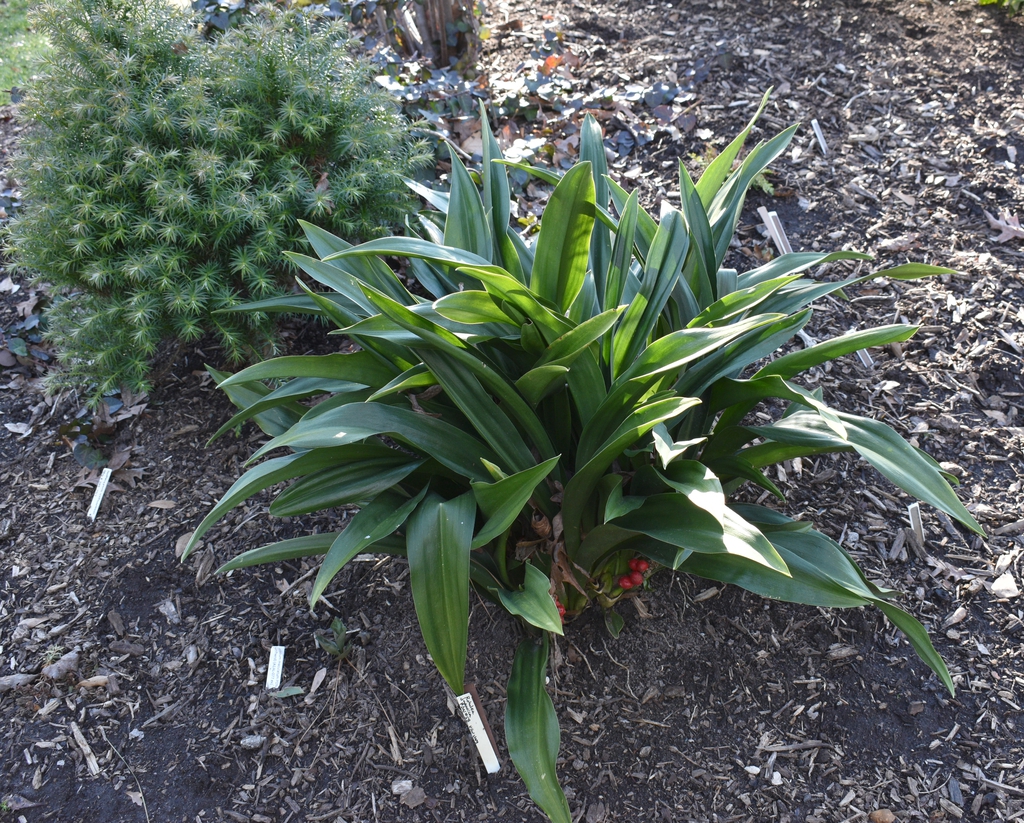
Cast iron plant
Aspidistra elatior
Care advice for Cast iron plant
Long, broad, leathery leaves rise separately from the compost. Most are dark green, although striped and speckled varieties are available.
- Light
- A position with gentle, indirect light suits it well. It tolerates lower light than many houseplants, but still needs daylight; avoid strong direct sun.
- Water
- Water when the surface of the compost has started to dry, then drain well. Water less in winter and avoid keeping the rootball constantly wet.
- Pot & compost
- Choose free-draining, peat-free houseplant compost and a pot with drainage holes.
- A little extra care
- Wipe dust from the leaves and feed lightly during active growth. Repot only when crowded; this is naturally a slow grower.
- What to look out for
- Scorched patches can follow strong sunshine. Check the compost before treating yellow leaves as a sign that it needs more water.
Further reading: RHS · NC State Extension
Photo: Cathy DeWitt · CC BY 4.0 · Photo source
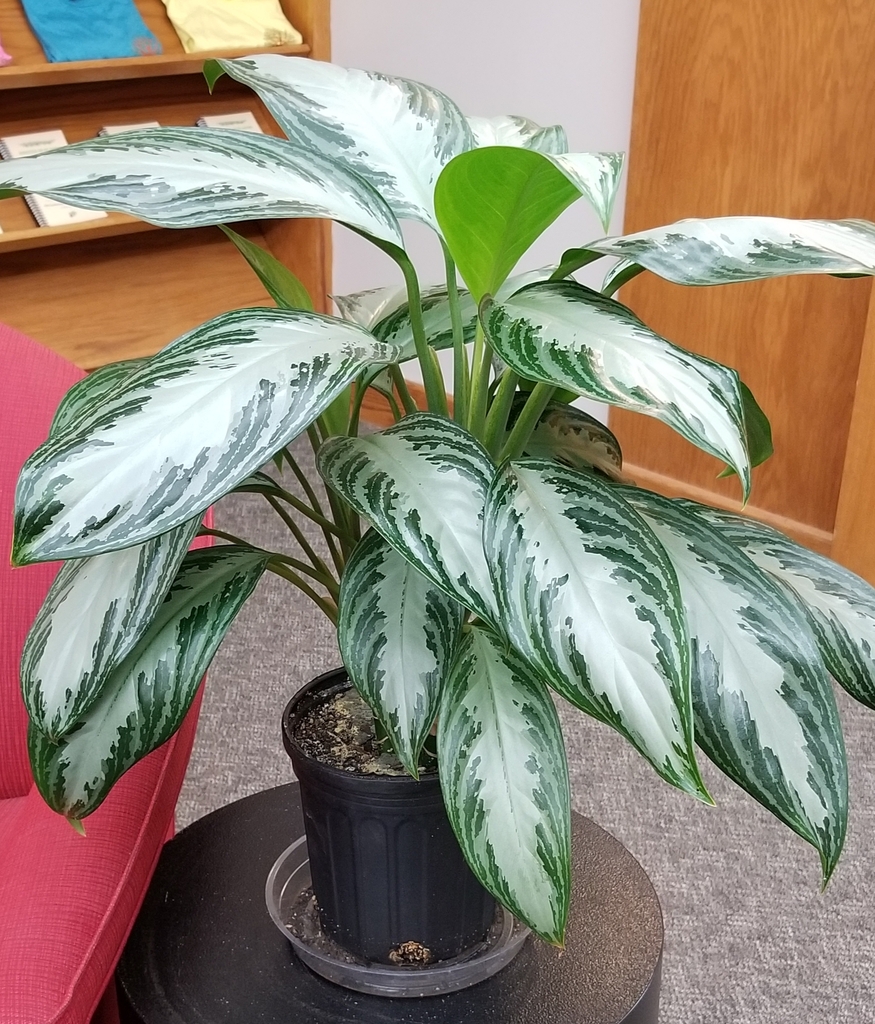
Chinese evergreen
Aglaonema species and hybrids
Care advice for Chinese evergreen
Broad, pointed leaves often have silver, cream, pink or red markings. Colour and leaf shape vary considerably between varieties.
- Light
- Bright, indirect light is ideal. Green varieties cope with lower light; more colourful plants usually need a brighter position to keep their markings.
- Water
- Allow the surface of the compost to dry slightly before watering, then drain completely. Reduce watering when growth slows in winter.
- Pot & compost
- Use free-draining, peat-free houseplant compost in a pot with drainage holes.
- A little extra care
- Keep it warm and away from cold draughts. Wipe the leaves occasionally and feed lightly while it is growing.
- What to look out for
- Brown edges can follow cold draughts or dry air. Yellow leaves with wet compost can point to overwatering.
Harmful if chewed or eaten; the sap can irritate skin. Wear gloves when cutting stems and keep away from children and pets that chew plants.
Further reading: RHS · NC State Extension
Photo: Cindy Christian · CC BY 4.0 · Photo source
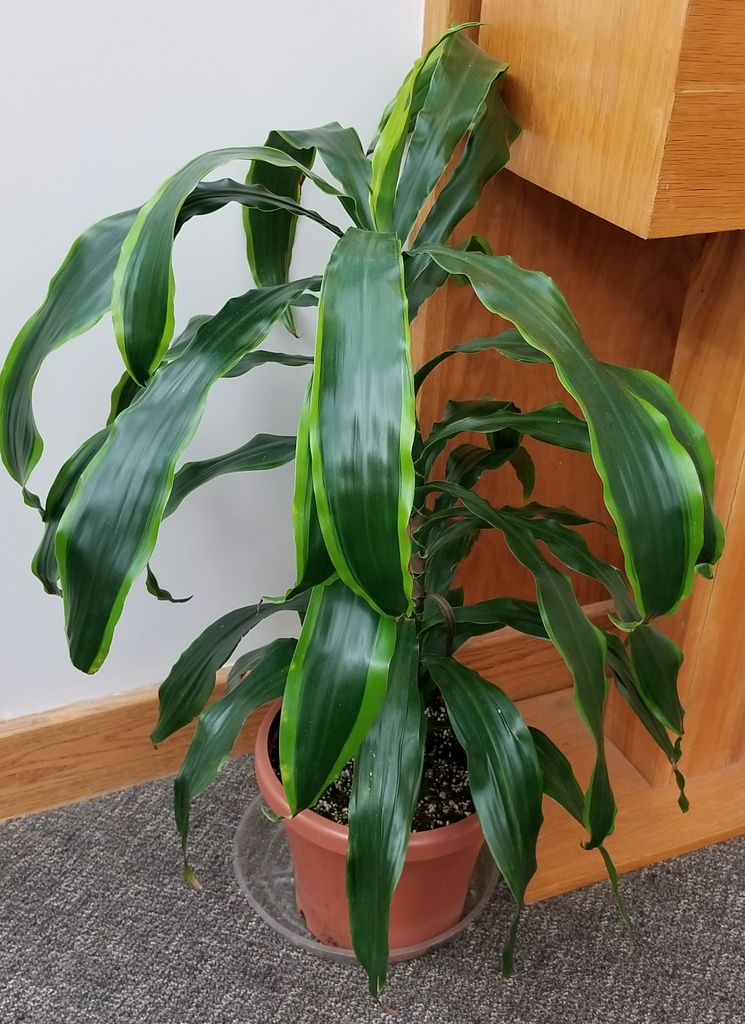
Corn plant
Dracaena fragrans
Care advice for Corn plant
Broad, arching, strap-like leaves grow in tufts on woody canes. Many varieties have a yellow, lime-green or cream stripe.
- Light
- Give it bright to moderate, indirect light. Avoid strong sunshine through glass, which can burn the leaves.
- Water
- Let the top of the compost start to dry before watering. Keep the roots gently moist during active growth, never waterlogged, and water less in winter.
- Pot & compost
- Use free-draining, peat-free houseplant compost and an inner pot with drainage holes.
- A little extra care
- Keep away from cold draughts and radiators. Wipe dusty leaves and feed lightly while new growth is appearing.
- What to look out for
- Brown tips can have several causes, including dry air and salts in the water or fertiliser. If persistent, try rainwater or distilled water and review feeding.
Keep away from pets that chew plants.
Further reading: NC State Extension
Photo: Cindy Christian · CC BY 4.0 · Photo source
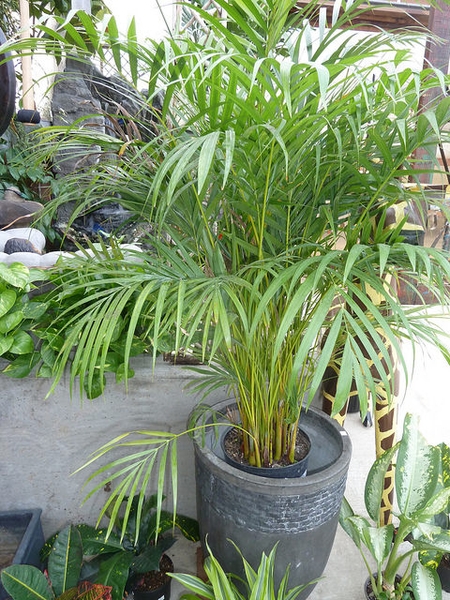
Areca palm
Chrysalidocarpus lutescens
Also sold as Dypsis lutescens
Care advice for Areca palm
Clusters of slender, bamboo-like canes carry arching, feathery fronds. The stems and leaf stalks often have a yellow-green tint.
- Light
- Choose a bright position with indirect light. Protect the fronds from strong direct sunshine through glass.
- Water
- Keep the compost gently moist while growing and let excess water drain. In winter, let the surface dry slightly before watering; do not let the whole rootball become bone-dry.
- Pot & compost
- Use free-draining, peat-free houseplant or palm compost in a pot with drainage holes.
- A little extra care
- It appreciates humid air and a warm position away from radiators. Feed during active growth and remove only fully dead fronds.
- What to look out for
- Dry air can lead to brown tips and encourage spider mites. Check beneath the leaflets for fine webbing rather than simply adding more water.
Further reading: RHS · NC State Extension
Photo: Kathleen Moore · CC BY 2.0 · Photo source
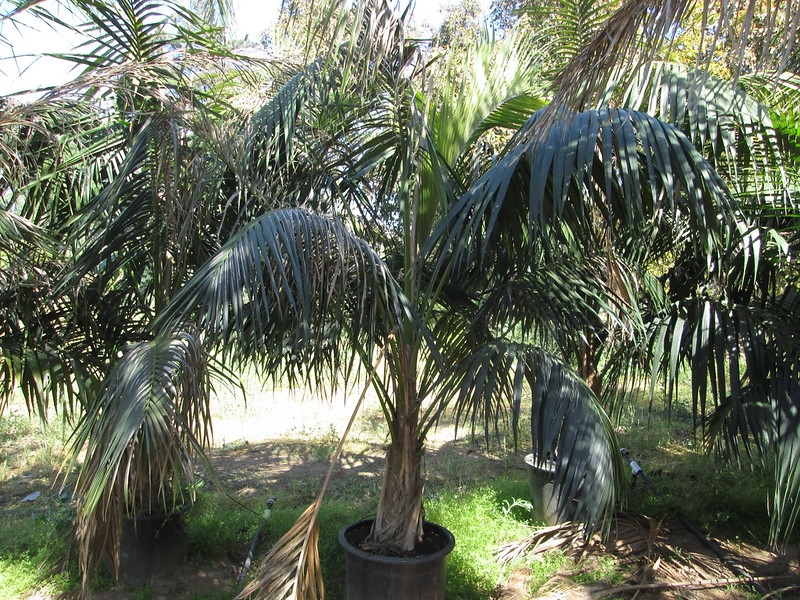
Kentia palm
Howea forsteriana
Care advice for Kentia palm
Long, arching fronds have slender, drooping leaflets. Several young palms are often grown together in one pot for a fuller appearance.
- Light
- Bright, indirect light suits it well, although it tolerates a position with less daylight. Keep it out of harsh direct sunshine.
- Water
- Keep the rootball gently moist during active growth and always drain excess water. Let the surface dry slightly between winter waterings.
- Pot & compost
- Use free-draining, peat-free palm or houseplant compost. Avoid moving it into a much larger pot.
- A little extra care
- Keep away from cold draughts and direct radiator heat. Feed lightly while growing, and repot only when needed with as little root disturbance as possible.
- What to look out for
- Remove fully brown fronds, but leave healthy green ones and the central growing point. Check brown tips alongside watering, humidity and feeding.
Further reading: RHS · NC State Extension
Photo: East West Trees · CC BY 2.0 · Photo source
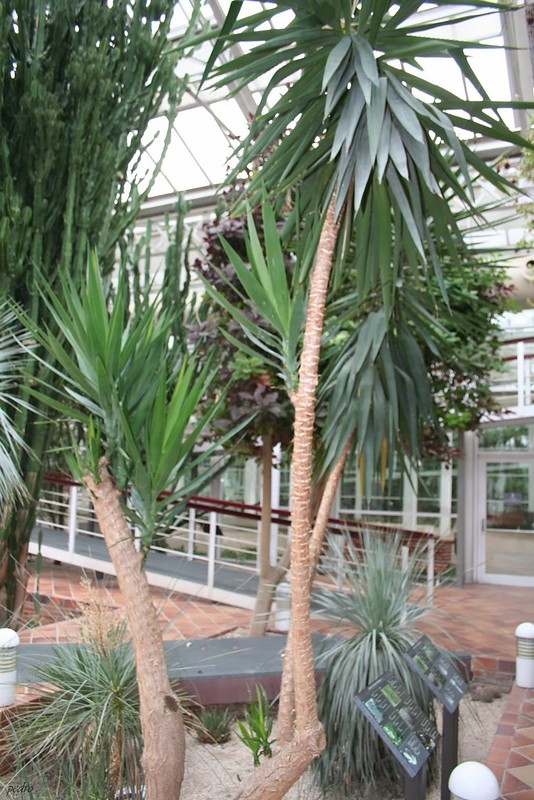
Spineless yucca
Yucca gigantea
Also sold as Yucca elephantipes
Care advice for Spineless yucca
Upright woody canes carry rosettes of stiff, sword-shaped green leaves. Older plants may have a thick, swollen trunk base.
- Light
- Give it a very bright position. It can take sunshine, but introduce stronger light gradually if it has been kept in shade.
- Water
- Let most of the compost dry before watering thoroughly and draining. Give much less water in a cool, darker winter room.
- Pot & compost
- Choose a stable pot with drainage holes and a gritty, peat-free cactus or succulent compost.
- A little extra care
- Turn the pot occasionally for even growth. Remove dry lower leaves carefully and feed sparingly during active growth.
- What to look out for
- A soft cane or yellowing leaves with wet compost can indicate rot. Avoid cold draughts and standing water in the outer pot.
Harmful if eaten; keep away from pets that chew plants.
Further reading: NC State Extension
Photo: someone10x · CC BY 2.0 · Photo source
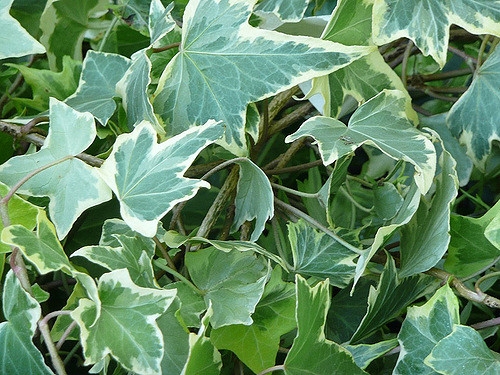
English ivy
Hedera helix
Care advice for English ivy
Trailing or climbing stems carry lobed leaves. Indoor varieties often have smaller leaves, sometimes edged or splashed with cream or yellow.
- Light
- Give it indirect light, with a brighter position for variegated varieties. It tolerates some shade and generally prefers a cooler room to a hot spot beside a radiator.
- Water
- Water when the upper layer of compost has begun to dry. Drain well and check less often in winter, especially in a cool room.
- Pot & compost
- Use free-draining, peat-free multipurpose or houseplant compost in a pot with drainage holes.
- A little extra care
- Trim long stems to keep it bushy. Healthy stem cuttings can be rooted to make new plants.
- What to look out for
- Hot, dry rooms encourage spider mites. Look for pale, speckled leaves and fine webbing, and check the growing conditions.
Harmful if eaten and the sap can irritate skin. Wear gloves when pruning and keep away from children and pets that chew plants.
Further reading: RHS · NC State Extension
Photo: Cristina · CC BY 2.0 · Photo source
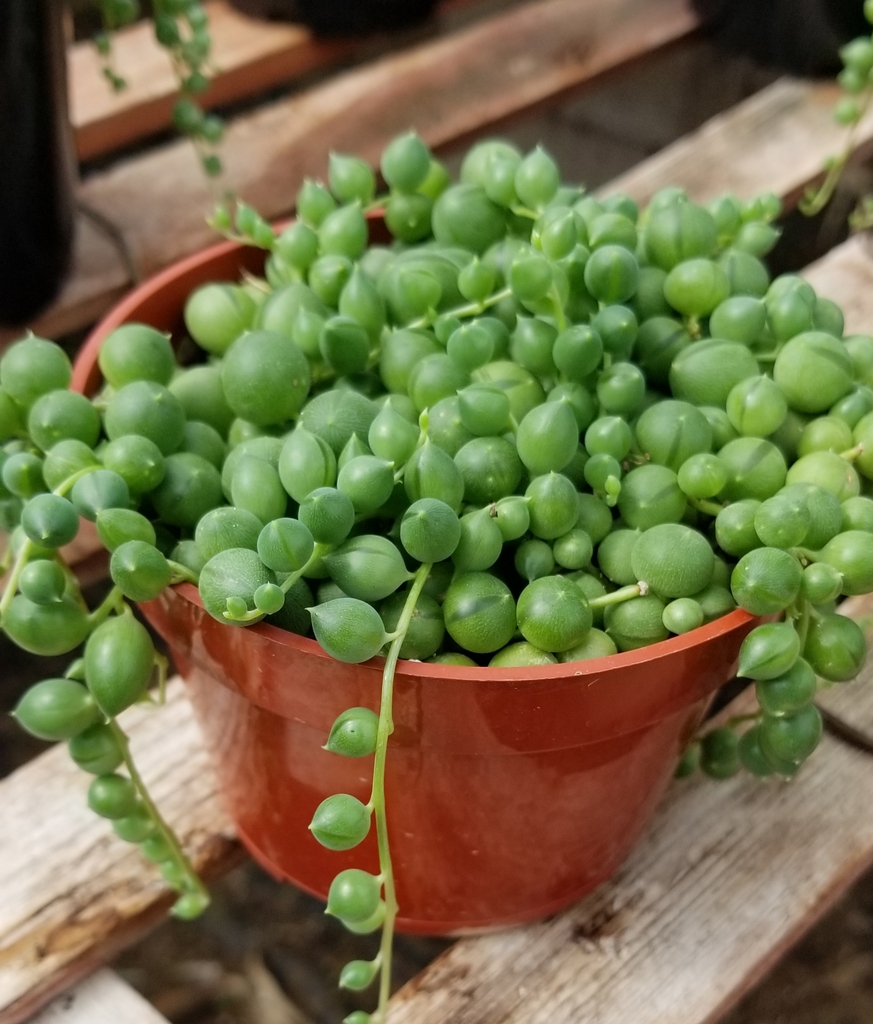
String of pearls
Curio rowleyanus
Formerly Senecio rowleyanus
Care advice for String of pearls
Small, round, pea-like leaves grow along slender trailing stems, creating strings of green beads over the edge of the pot.
- Light
- Choose bright, indirect light, with light reaching the top of the pot as well as the trailing stems. Protect from strong midday summer sun.
- Water
- Let the compost dry between waterings, then water modestly and drain well. Water very sparingly in winter, without leaving the leaves shrivelled for long periods.
- Pot & compost
- Use gritty, peat-free cactus or succulent compost in a pot with drainage holes. Avoid an oversized pot.
- A little extra care
- Let the stems trail from a bright shelf or hanging planter. Feed sparingly during active growth; healthy stem cuttings can make replacement plants.
- What to look out for
- Soft, translucent leaves and wet compost can indicate overwatering. Sparse growth at the top may mean too little light.
Harmful if eaten; the sap can irritate skin. Wear gloves when pruning and keep out of reach of children and pets.
Further reading: RHS · NC State Extension
Photo: Cindy Christian · CC BY 4.0 · Photo source
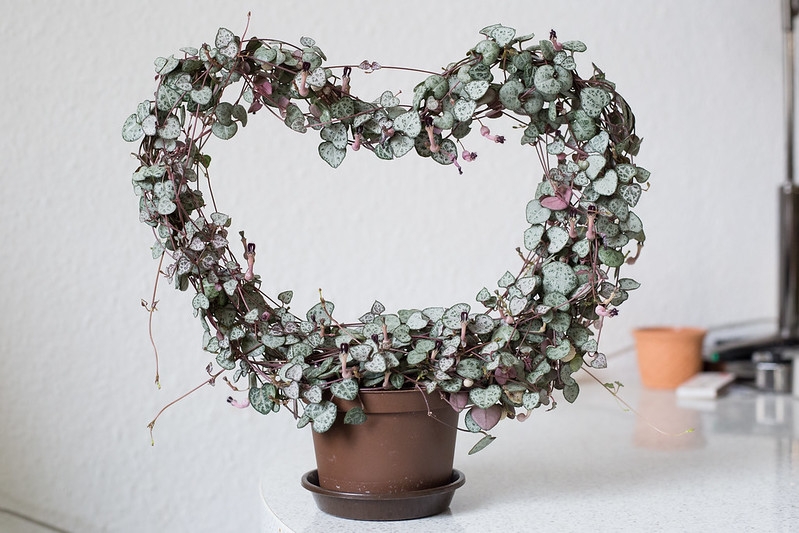
String of hearts
Ceropegia linearis subsp. woodii
Also sold as Ceropegia woodii
Care advice for String of hearts
Small, heart-shaped leaves with silver-green markings and purple undersides grow in pairs along wiry trailing stems.
- Light
- Give it bright, indirect light. A little gentle sunshine can suit it, but introduce stronger light gradually.
- Water
- Allow the compost to dry between waterings, then water and drain. Reduce watering further in winter when growth slows.
- Pot & compost
- Use a small pot with drainage holes and gritty, peat-free cactus or succulent compost.
- A little extra care
- Leave room for the stems to trail or guide them around a small support. Repot only when necessary and feed sparingly while growing.
- What to look out for
- Long gaps between leaves can mean too little light. Small bead-like growths on the stems are normal tubers and can be used for propagation.
Further reading: NC State Extension
Photo: Maja Dumat · CC BY 2.0 · Photo source
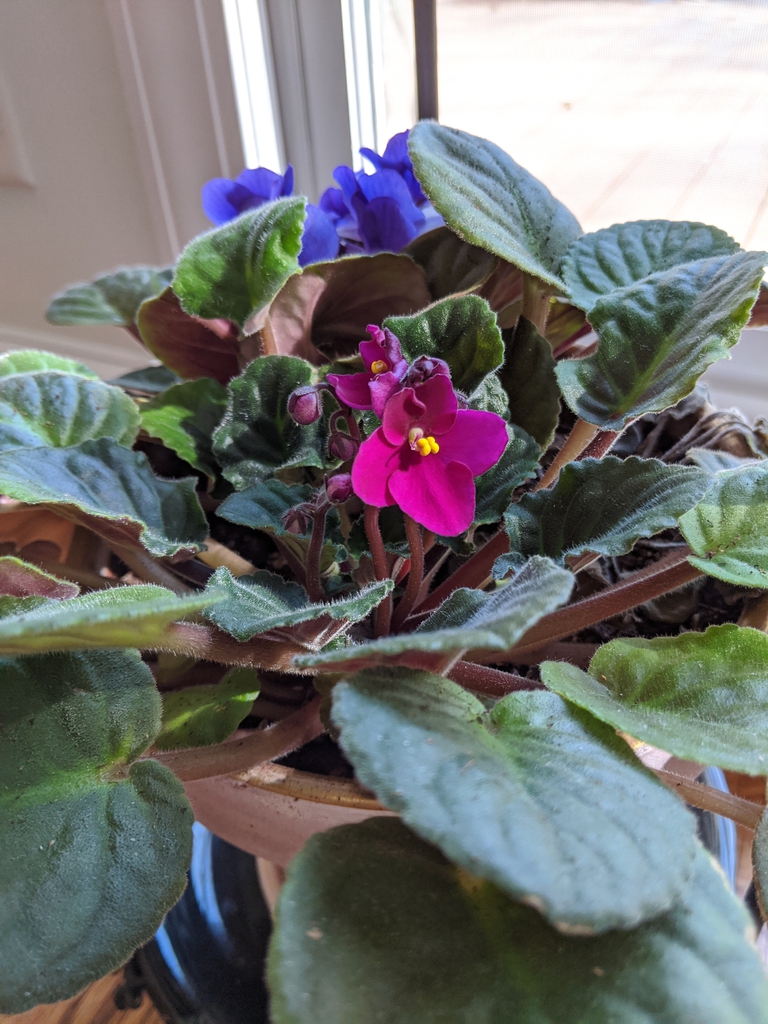
African violet
Streptocarpus ionanthus hybrids
Formerly Saintpaulia ionantha
Care advice for African violet
A compact rosette of soft, furry leaves supports clusters of violet, pink, white or blue flowers. Many flower colours and forms are available.
- Light
- Choose bright, filtered light, away from strong summer sunshine. Too little light can reduce flowering.
- Water
- Water with room-temperature water when the compost surface begins to dry. Keep the crown and leaves dry; if watering from below, drain away any water left afterwards.
- Pot & compost
- Use a light, free-draining, peat-free houseplant or African violet compost in a small pot with drainage holes.
- A little extra care
- Keep it consistently warm, away from cold draughts. Remove faded blooms carefully and feed with an appropriate flowering-houseplant fertiliser while growing.
- What to look out for
- Cold water on the leaves can leave marks. Soft crowns and persistently wet compost can indicate rot.
Further reading: RHS · NC State Extension
Photo: Hope Duckworth · CC BY 4.0 · Photo source
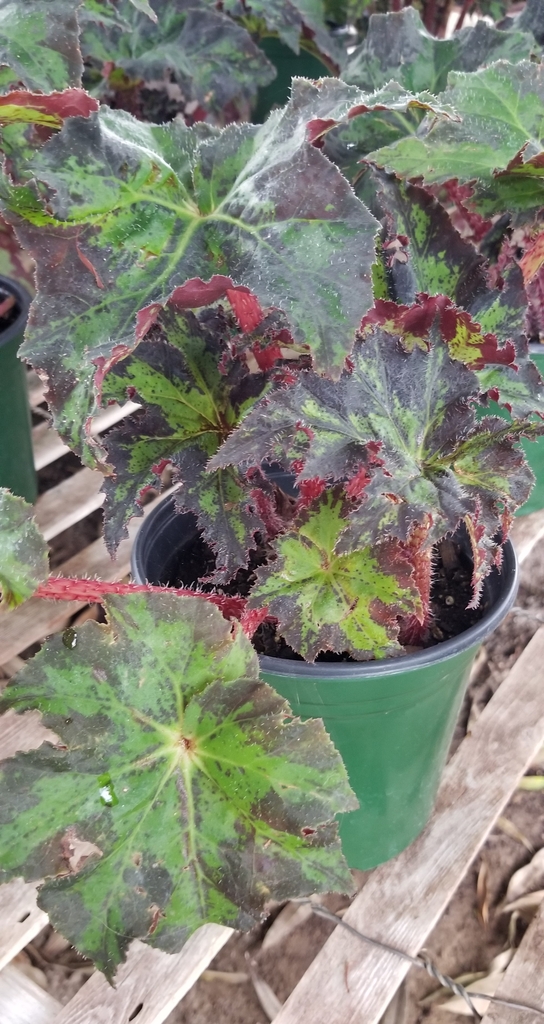
Rex begonia
Begonia Rex Cultorum Group
Care advice for Rex begonia
Large, often asymmetrical leaves have striking silver, green, pink, red or purple patterns. Some varieties have curled or spiralling leaves.
- Light
- Bright, indirect light shows off the foliage without scorching it. Avoid hot, direct sunshine.
- Water
- Water when the surface of the compost starts to dry, keeping it gently moist below. Drain well and use less water in winter.
- Pot & compost
- Use a light, free-draining, peat-free houseplant compost and a pot with drainage holes.
- A little extra care
- Give it warm, humid conditions with gentle air movement. A bright kitchen or bathroom can suit it. Remove dead leaves and avoid misting the foliage.
- What to look out for
- Powdery patches or rotting leaves can follow poor airflow or prolonged wetness. Keep water off the leaves and do not leave the pot standing in water.
Harmful to pets if eaten; keep away from animals that chew plants.
Further reading: RHS · NC State Extension
Photo: Cindy Christian · CC BY 4.0 · Photo source
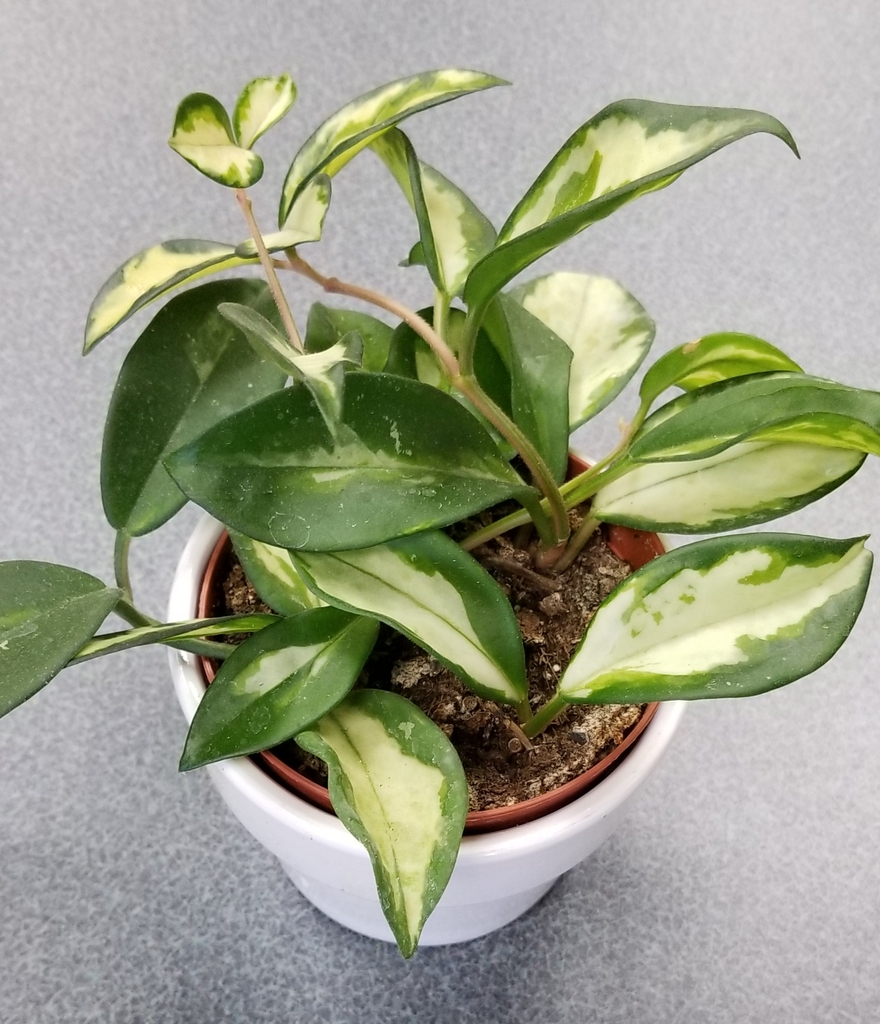
Wax plant / hoya
Hoya carnosa
Care advice for Wax plant / hoya
Thick, waxy leaves grow along trailing or climbing stems. Mature plants may produce rounded clusters of fragrant, star-shaped flowers.
- Light
- Give it bright, indirect light. Too little daylight can prevent flowering; protect it from hot midday sun.
- Water
- Let the upper compost dry before watering, then drain fully. Avoid both constant sogginess and prolonged drought, and reduce watering in winter.
- Pot & compost
- Choose an airy, fast-draining, peat-free mix with bark or perlite, in a pot with drainage holes.
- A little extra care
- Train long stems onto a support or let them trail. Leave the short flower spurs in place after blooming, as they can flower again.
- What to look out for
- Avoid moving the plant while it is in bud. Bud drop can follow changes in light or compost that is too wet or too dry.
Further reading: RHS · NC State Extension
Photo: Matt Stevens (Pitt County) · CC BY 4.0 · Photo source
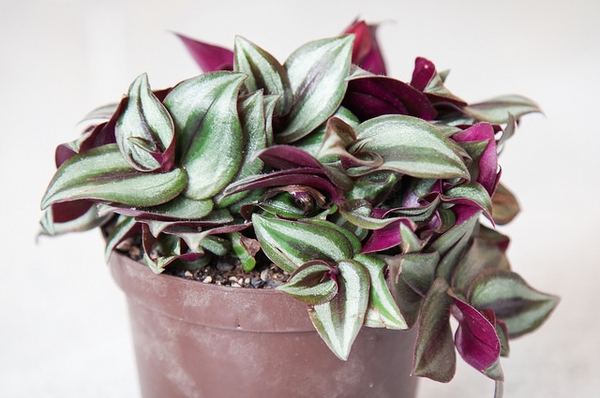
Inch plant
Tradescantia zebrina
Care advice for Inch plant
Trailing stems carry pointed leaves striped with silver and green, usually with purple undersides. The stems root readily at their joints.
- Light
- Bright, filtered light keeps the colours strong and the growth compact. Protect from intense summer sunshine.
- Water
- Let the top of the compost begin to dry before watering. Drain well, and reduce watering when growth slows in winter.
- Pot & compost
- Use free-draining, peat-free houseplant compost and a pot with drainage holes.
- A little extra care
- Pinch out shoot tips or trim long stems to encourage bushier growth. Healthy stem cuttings are an easy way to refresh an older plant.
- What to look out for
- Long, bare stems and fading leaf colour can mean too little light. Soft stems with soggy compost may indicate rot.
The sap can irritate skin; wear gloves when pruning and keep away from pets that chew plants.
Further reading: NC State Extension
Photo: Maja Dumat · CC BY 4.0 · Photo source
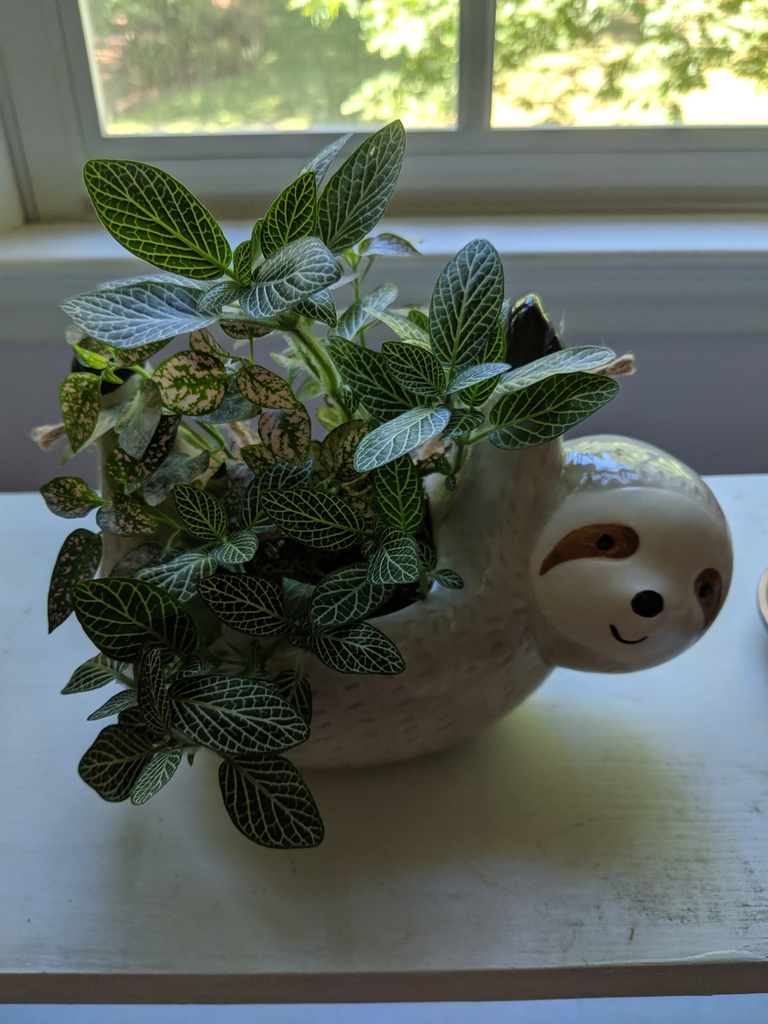
Nerve plant
Fittonia albivenis
Care advice for Nerve plant
Small, oval leaves have a network of white, pink or red veins. It forms a low, spreading plant with soft stems.
- Light
- Choose bright to moderate, indirect light. Strong direct sun can scorch the delicate leaves.
- Water
- Keep the compost lightly and evenly moist, watering as the surface starts to dry. Do not let it become bone-dry or leave it standing in water.
- Pot & compost
- Use moisture-retentive but free-draining, peat-free houseplant compost. Its shallow roots suit a relatively small pot.
- A little extra care
- Keep in a humid position away from cold draughts. Pinch out long shoots to encourage a fuller plant; small varieties can suit a terrarium.
- What to look out for
- It can wilt dramatically when dry, but wet roots can also cause wilting. Feel the compost before watering rather than treating every droop the same way.
Further reading: NC State Extension
Photo: Hope Duckworth · CC BY 4.0 · Photo source
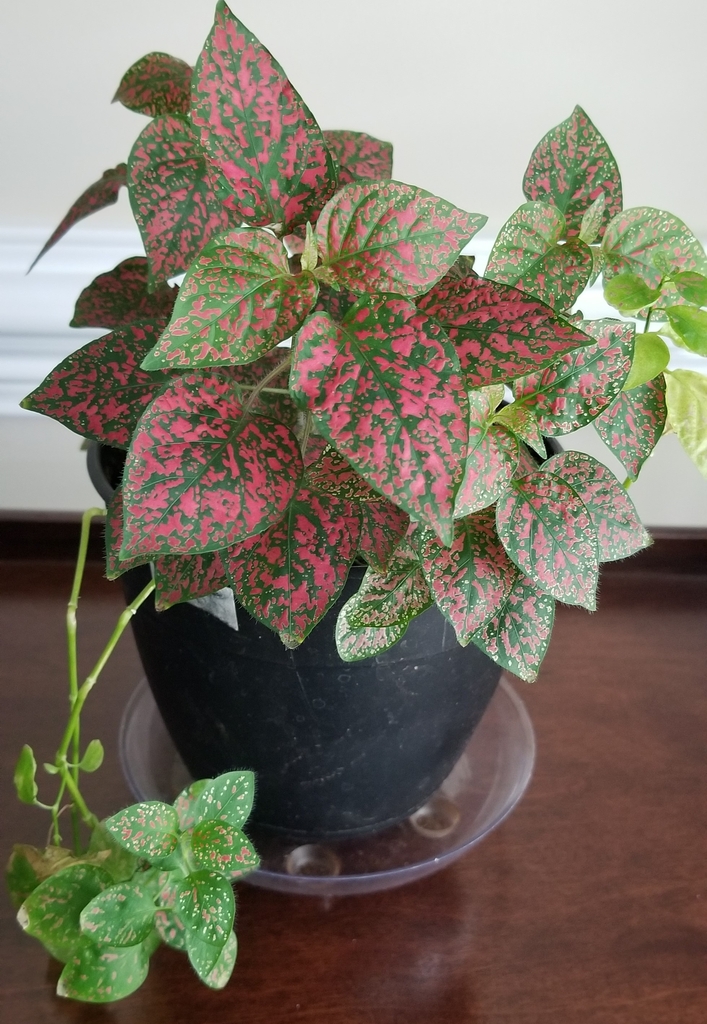
Polka dot plant
Hypoestes phyllostachya
Care advice for Polka dot plant
Soft, oval leaves are splashed or spotted with pink, red or white. The markings vary widely between varieties.
- Light
- Give it bright, indirect light to keep the colours clear and growth compact. Avoid scorching summer sunshine.
- Water
- Keep the compost gently moist while growing, watering when the surface begins to dry. Drain excess water and reduce watering in winter.
- Pot & compost
- Use free-draining, peat-free houseplant compost in a pot with drainage holes.
- A little extra care
- Pinch out growing tips regularly to keep it bushy. It is often short-lived indoors, but healthy stem cuttings can give you fresh plants.
- What to look out for
- Long, weak stems and fading markings can indicate too little light. Wilting calls for a compost check, as both dryness and wet roots can cause problems.
Further reading: NC State Extension
Photo: Cindy Christian · CC BY 4.0 · Photo source
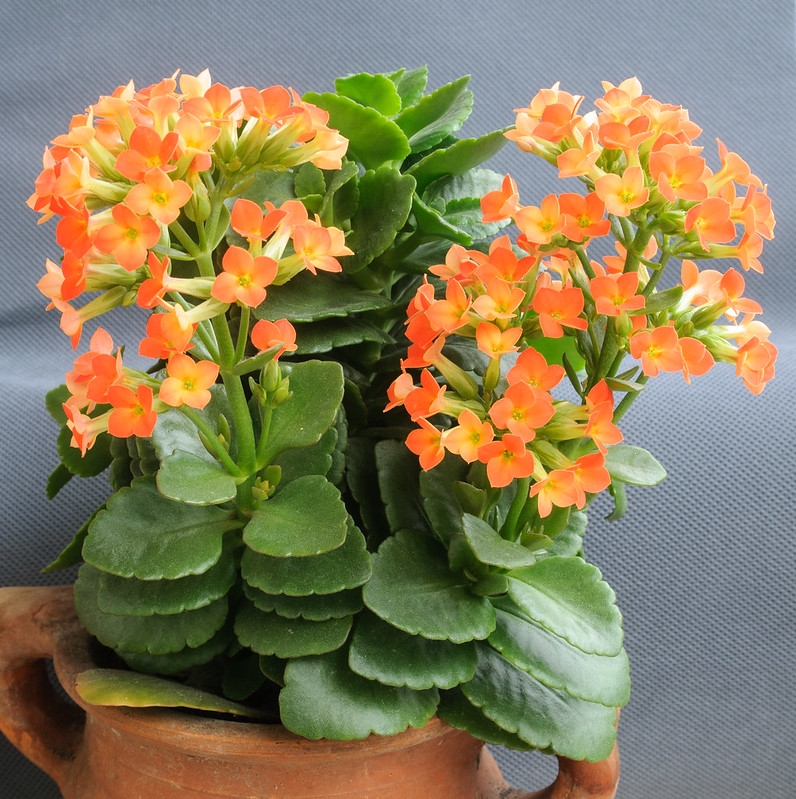
Flaming Katy / kalanchoe
Kalanchoe blossfeldiana
Care advice for Flaming Katy / kalanchoe
Glossy, fleshy leaves with scalloped edges support clusters of small, long-lasting flowers in bright colours. Double-flowered varieties are also common.
- Light
- Give it plenty of bright light, protecting it from intense midday summer sunshine.
- Water
- Let the compost dry between waterings, then water and drain thoroughly. It needs much less water when growth slows.
- Pot & compost
- Use free-draining, peat-free cactus or succulent compost and a pot with drainage holes.
- A little extra care
- Remove faded flower clusters and feed lightly during active growth. To flower again, it needs a period of long, uninterrupted nights; normal evening room lighting can interfere.
- What to look out for
- Soft stems or yellow leaves with wet compost can indicate rot. A plant that has finished flowering can still grow on as a leafy succulent.
Harmful if eaten; keep out of reach of children and pets that chew plants.
Further reading: RHS · NC State Extension
Photo: Lyubo Gadzhev · CC-BY-SA 2.0 · Photo source
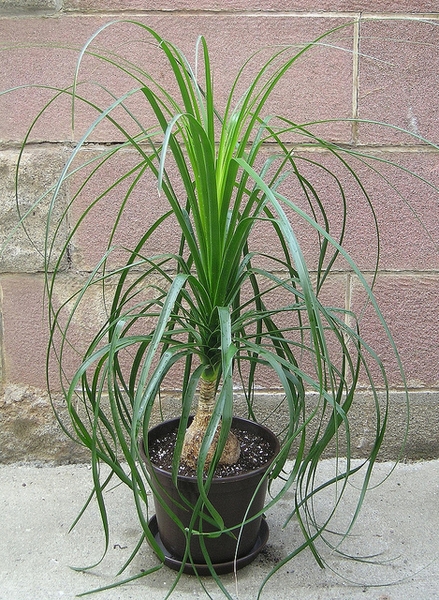
Ponytail palm
Beaucarnea recurvata
Care advice for Ponytail palm
A swollen, bottle-shaped trunk stores water, while long, narrow leaves curl down from the top like a ponytail. It is not a true palm.
- Light
- Choose a very bright position, including some sunshine. Introduce stronger light gradually if moving it from a darker spot.
- Water
- Let the compost dry between waterings, then water and drain well. Give very little water during a cool, darker winter.
- Pot & compost
- Use gritty, peat-free cactus or succulent compost in a stable pot with drainage holes. Keep the swollen trunk base above the compost surface.
- A little extra care
- Feed sparingly during active growth and repot only when needed. Normal household humidity generally suits it.
- What to look out for
- A soft trunk base with wet compost can signal rot. A few dry lower leaves are normal as it grows.
Further reading: NC State Extension
Photo: Maja Dumat · CC BY 4.0 · Photo source
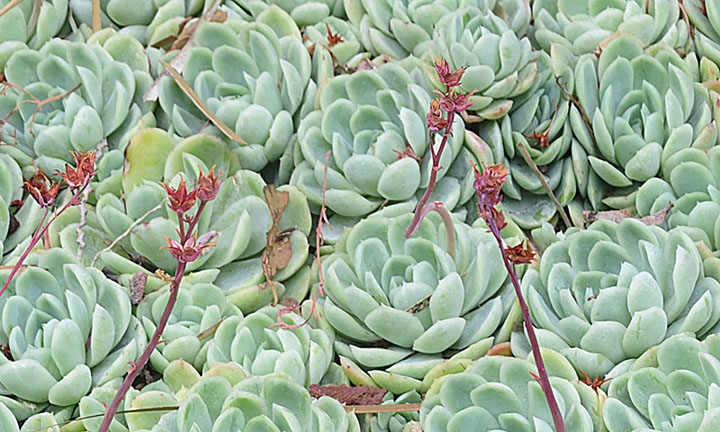
Echeveria
Echeveria elegans
Care advice for Echeveria
Fleshy leaves form a neat, rose-like rosette, often in pale green or blue-grey. Mature plants may make small offsets around the base.
- Light
- Give it the brightest practical position, with some sunshine. Introduce stronger sun gradually to avoid scorching.
- Water
- Let the compost dry between waterings. Water the compost rather than filling the leaf rosette, then drain well; reduce watering greatly in winter.
- Pot & compost
- Use a small pot with drainage holes and gritty, peat-free cactus or succulent compost.
- A little extra care
- Turn the pot occasionally for even growth and feed sparingly while growing. Handle gently to preserve the natural powdery coating on the leaves.
- What to look out for
- An open, stretched rosette often needs more light. Soft, translucent leaves with wet compost can point to overwatering.
Further reading: RHS · NC State Extension
Photo: Dick Culbert · CC BY 2.0 · Photo source
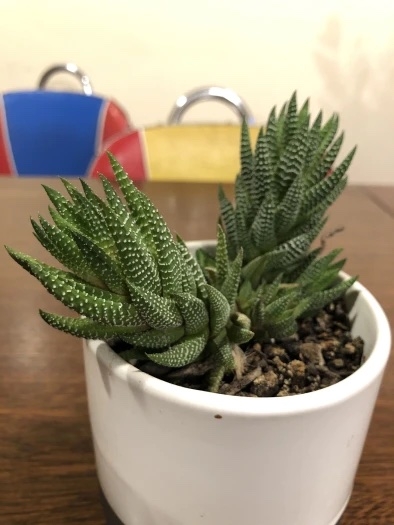
Zebra haworthia
Haworthiopsis attenuata
Also sold as Haworthia attenuata
Care advice for Zebra haworthia
A compact rosette of pointed, dark green leaves is covered with raised white spots or bands. Offsets often form around the base.
- Light
- Bright, indirect light is ideal. Protect it from hot, direct summer sunshine through glass.
- Water
- Allow the compost to dry between waterings, then water and drain completely. Reduce watering in winter and keep water out of the centre of the rosette.
- Pot & compost
- Use gritty, peat-free cactus or succulent compost in a small pot with drainage holes.
- A little extra care
- Feed sparingly during active growth. Established offsets can be separated carefully when they have developed roots.
- What to look out for
- Soft, yellowing leaves with wet compost can indicate rot. This plant is often sold under the older name Haworthia; check the botanical name when buying.
Further reading: RHS · NC State Extension
Photo: Guillaume Clin · CC BY 4.0 · Photo source
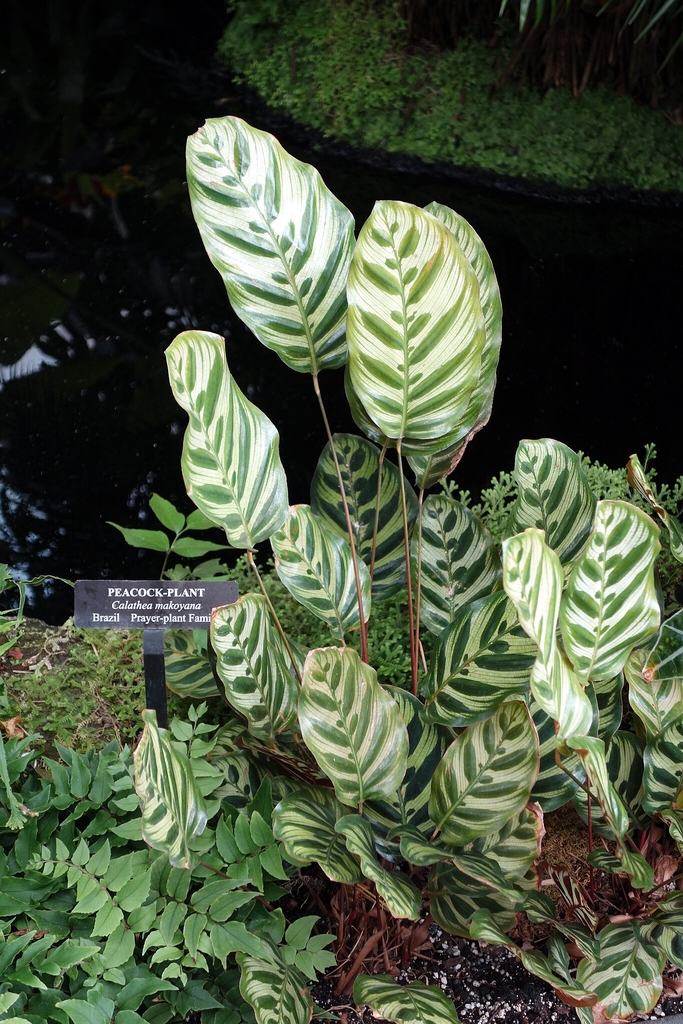
Peacock plant / calathea
Goeppertia makoyana
Also sold as Calathea makoyana
Care advice for Peacock plant / calathea
Pale, oval leaves have dark green feather-like markings and patterned purple undersides. The leaves often lift or fold upwards at night.
- Light
- Choose bright, indirect light, away from strong direct sun. Very low light can weaken the growth and leaf markings.
- Water
- Keep the compost evenly moist during active growth, never soggy. Let the surface begin to dry in winter and use room-temperature rainwater or distilled water where possible.
- Pot & compost
- Use moisture-retentive but airy, free-draining, peat-free houseplant compost and a pot with drainage holes.
- A little extra care
- Keep it warm and humid, away from cold draughts and radiators. Gently wipe dusty leaves and feed lightly during active growth.
- What to look out for
- Curling leaves or brown edges can follow dry air, inconsistent watering or water quality problems. Check all three before adding more water.
Further reading: RHS · NC State Extension
Photo: Daderot · CC0 1.0 · Photo source
No plants found. Try another name, or clear the search to see all 40.
A few good habits
- Check first, then water. Light, warmth and pot size change how quickly compost dries. A fixed weekly schedule will not suit every plant.
- Let excess water escape. Choose a pot with drainage holes and empty the saucer or decorative outer pot after watering.
- Follow the seasons. Most plants use less water and feed when growth slows in a darker winter room. Orchids and seasonal flowering plants have their own needs.
- Check the name on the label. Common names can overlap. Jade plants and Chinese money plants, for example, need different care.
Need a hand with your plant?
Bring the plant name and a clear photograph of any problem when you contact us. We can discuss what you have tried and help you work out the next step.
Ask about your plantA little help to take home.
Each QR label opens the matching care guide. Print the A4 sheets, cut out the labels and add them to your pots.
Jade plant / money plant
Crassula ovata
Scan for your care guide
abilitygrows.org.uk/plant-shop/growing-guides/#jade-plant
Ability Grows
Plants. People. Community.
Spider plant
Chlorophytum comosum
Scan for your care guide
abilitygrows.org.uk/plant-shop/growing-guides/#spider-plant
Ability Grows
Plants. People. Community.
Peace lily
Spathiphyllum
Scan for your care guide
abilitygrows.org.uk/plant-shop/growing-guides/#peace-lily
Ability Grows
Plants. People. Community.
Monstera / Swiss cheese plant
Monstera deliciosa
Scan for your care guide
abilitygrows.org.uk/plant-shop/growing-guides/#monstera
Ability Grows
Plants. People. Community.
Pothos / devil’s ivy
Epipremnum aureum
Scan for your care guide
abilitygrows.org.uk/plant-shop/growing-guides/#pothos
Ability Grows
Plants. People. Community.
Snake plant
Dracaena trifasciata
Scan for your care guide
abilitygrows.org.uk/plant-shop/growing-guides/#snake-plant
Ability Grows
Plants. People. Community.
ZZ plant
Zamioculcas zamiifolia
Scan for your care guide
abilitygrows.org.uk/plant-shop/growing-guides/#zz-plant
Ability Grows
Plants. People. Community.
Rubber plant
Ficus elastica
Scan for your care guide
abilitygrows.org.uk/plant-shop/growing-guides/#rubber-plant
Ability Grows
Plants. People. Community.
Weeping fig
Ficus benjamina
Scan for your care guide
abilitygrows.org.uk/plant-shop/growing-guides/#weeping-fig
Ability Grows
Plants. People. Community.
Fiddle-leaf fig
Ficus lyrata
Scan for your care guide
abilitygrows.org.uk/plant-shop/growing-guides/#fiddle-leaf-fig
Ability Grows
Plants. People. Community.
Heartleaf philodendron
Philodendron hederaceum
Scan for your care guide
abilitygrows.org.uk/plant-shop/growing-guides/#heartleaf-philodendron
Ability Grows
Plants. People. Community.
Chinese money plant
Pilea peperomioides
Scan for your care guide
abilitygrows.org.uk/plant-shop/growing-guides/#chinese-money-plant
Ability Grows
Plants. People. Community.
Aloe vera
Aloe vera
Scan for your care guide
abilitygrows.org.uk/plant-shop/growing-guides/#aloe-vera
Ability Grows
Plants. People. Community.
Boston fern
Nephrolepis exaltata
Scan for your care guide
abilitygrows.org.uk/plant-shop/growing-guides/#boston-fern
Ability Grows
Plants. People. Community.
Parlour palm
Chamaedorea elegans
Scan for your care guide
abilitygrows.org.uk/plant-shop/growing-guides/#parlour-palm
Ability Grows
Plants. People. Community.
Moth orchid
Phalaenopsis hybrids
Scan for your care guide
abilitygrows.org.uk/plant-shop/growing-guides/#moth-orchid
Ability Grows
Plants. People. Community.
Christmas cactus
Schlumbergera hybrids
Scan for your care guide
abilitygrows.org.uk/plant-shop/growing-guides/#christmas-cactus
Ability Grows
Plants. People. Community.
Flamingo flower
Anthurium andraeanum hybrids
Scan for your care guide
abilitygrows.org.uk/plant-shop/growing-guides/#flamingo-flower
Ability Grows
Plants. People. Community.
Dragon tree
Dracaena reflexa var. angustifolia
Scan for your care guide
abilitygrows.org.uk/plant-shop/growing-guides/#dragon-tree
Ability Grows
Plants. People. Community.
Prayer plant
Maranta leuconeura
Scan for your care guide
abilitygrows.org.uk/plant-shop/growing-guides/#prayer-plant
Ability Grows
Plants. People. Community.
Cast iron plant
Aspidistra elatior
Scan for your care guide
abilitygrows.org.uk/plant-shop/growing-guides/#cast-iron-plant
Ability Grows
Plants. People. Community.
Chinese evergreen
Aglaonema species and hybrids
Scan for your care guide
abilitygrows.org.uk/plant-shop/growing-guides/#chinese-evergreen
Ability Grows
Plants. People. Community.
Corn plant
Dracaena fragrans
Scan for your care guide
abilitygrows.org.uk/plant-shop/growing-guides/#corn-plant
Ability Grows
Plants. People. Community.
Areca palm
Chrysalidocarpus lutescens
Scan for your care guide
abilitygrows.org.uk/plant-shop/growing-guides/#areca-palm
Ability Grows
Plants. People. Community.
Kentia palm
Howea forsteriana
Scan for your care guide
abilitygrows.org.uk/plant-shop/growing-guides/#kentia-palm
Ability Grows
Plants. People. Community.
Spineless yucca
Yucca gigantea
Scan for your care guide
abilitygrows.org.uk/plant-shop/growing-guides/#yucca
Ability Grows
Plants. People. Community.
English ivy
Hedera helix
Scan for your care guide
abilitygrows.org.uk/plant-shop/growing-guides/#english-ivy
Ability Grows
Plants. People. Community.
String of pearls
Curio rowleyanus
Scan for your care guide
abilitygrows.org.uk/plant-shop/growing-guides/#string-of-pearls
Ability Grows
Plants. People. Community.
String of hearts
Ceropegia linearis subsp. woodii
Scan for your care guide
abilitygrows.org.uk/plant-shop/growing-guides/#string-of-hearts
Ability Grows
Plants. People. Community.
African violet
Streptocarpus ionanthus hybrids
Scan for your care guide
abilitygrows.org.uk/plant-shop/growing-guides/#african-violet
Ability Grows
Plants. People. Community.
Rex begonia
Begonia Rex Cultorum Group
Scan for your care guide
abilitygrows.org.uk/plant-shop/growing-guides/#rex-begonia
Ability Grows
Plants. People. Community.
Wax plant / hoya
Hoya carnosa
Scan for your care guide
abilitygrows.org.uk/plant-shop/growing-guides/#wax-plant
Ability Grows
Plants. People. Community.
Inch plant
Tradescantia zebrina
Scan for your care guide
abilitygrows.org.uk/plant-shop/growing-guides/#inch-plant
Ability Grows
Plants. People. Community.
Nerve plant
Fittonia albivenis
Scan for your care guide
abilitygrows.org.uk/plant-shop/growing-guides/#nerve-plant
Ability Grows
Plants. People. Community.
Polka dot plant
Hypoestes phyllostachya
Scan for your care guide
abilitygrows.org.uk/plant-shop/growing-guides/#polka-dot-plant
Ability Grows
Plants. People. Community.
Flaming Katy / kalanchoe
Kalanchoe blossfeldiana
Scan for your care guide
abilitygrows.org.uk/plant-shop/growing-guides/#flaming-katy
Ability Grows
Plants. People. Community.
Ponytail palm
Beaucarnea recurvata
Scan for your care guide
abilitygrows.org.uk/plant-shop/growing-guides/#ponytail-palm
Ability Grows
Plants. People. Community.
Echeveria
Echeveria elegans
Scan for your care guide
abilitygrows.org.uk/plant-shop/growing-guides/#echeveria
Ability Grows
Plants. People. Community.
Zebra haworthia
Haworthiopsis attenuata
Scan for your care guide
abilitygrows.org.uk/plant-shop/growing-guides/#zebra-haworthia
Ability Grows
Plants. People. Community.
Peacock plant / calathea
Goeppertia makoyana
Scan for your care guide
abilitygrows.org.uk/plant-shop/growing-guides/#peacock-plant
Ability Grows
Plants. People. Community.
Written by Ability Grows in plain English, with care information checked against RHS and NC State Extension guidance · 1 November 2026. Photographs show typical examples; varieties and young plants may look different. Photo credits and further reading are included in each guide.